
What if the secret to a lasting watercolor tattoo isn't the presence of a black outline, but the depth of the ink saturation itself? Many enthusiasts hesitate to commit to this style because they fear their investment will eventually blur into something resembling a bruise. It's a valid concern, especially when you consider how the intense high-altitude sun in Colorado can impact the longevity of vibrant pigments. You deserve a piece of art that maintains its integrity long after you leave the studio.
We're here to show you that a watercolor tattoo Denver artists create can be both ethereal and enduring. This guide explores the technical artistry required to achieve painterly effects that stand the test of time. You'll learn how to choose the right color palette for your specific skin tone and why a professional, collaborative consultation is the foundation of a successful piece. We'll also cover the essential safety standards and design strategies used by master artisans in the Englewood area to ensure your custom body art remains a legible, vibrant masterpiece for years to come.
Key Takeaways
- Understand the "black skeleton" technique and how hidden structural integrity prevents painterly designs from blurring over time.
- Learn how a professional watercolor tattoo Denver artist combats high-altitude UV exposure to keep your pigments vibrant and legible.
- Discover the specific methods used to evaluate skin tones for optimal color selection and maximum visual impact.
- Explore the collaborative consultation process that transforms your artistic vision into a technically viable, custom design.
- Identify why a sterile environment and premium ink selection are critical for the long term safety and quality of your body art.
What Defines a Watercolor Tattoo in the Denver Art Scene?
Denver's art scene has always leaned toward the expressive and unconventional. While tattooing is a centuries-old form of body modification, the watercolor style represents a significant modern departure from traditional boundaries. A watercolor tattoo Denver residents choose often reflects the city's own creative energy. This style mimics the delicate brushstrokes, spontaneous splatters, and soft gradients typically found in a fine art gallery. It's a visual language that prioritizes fluid movement over rigid structure.
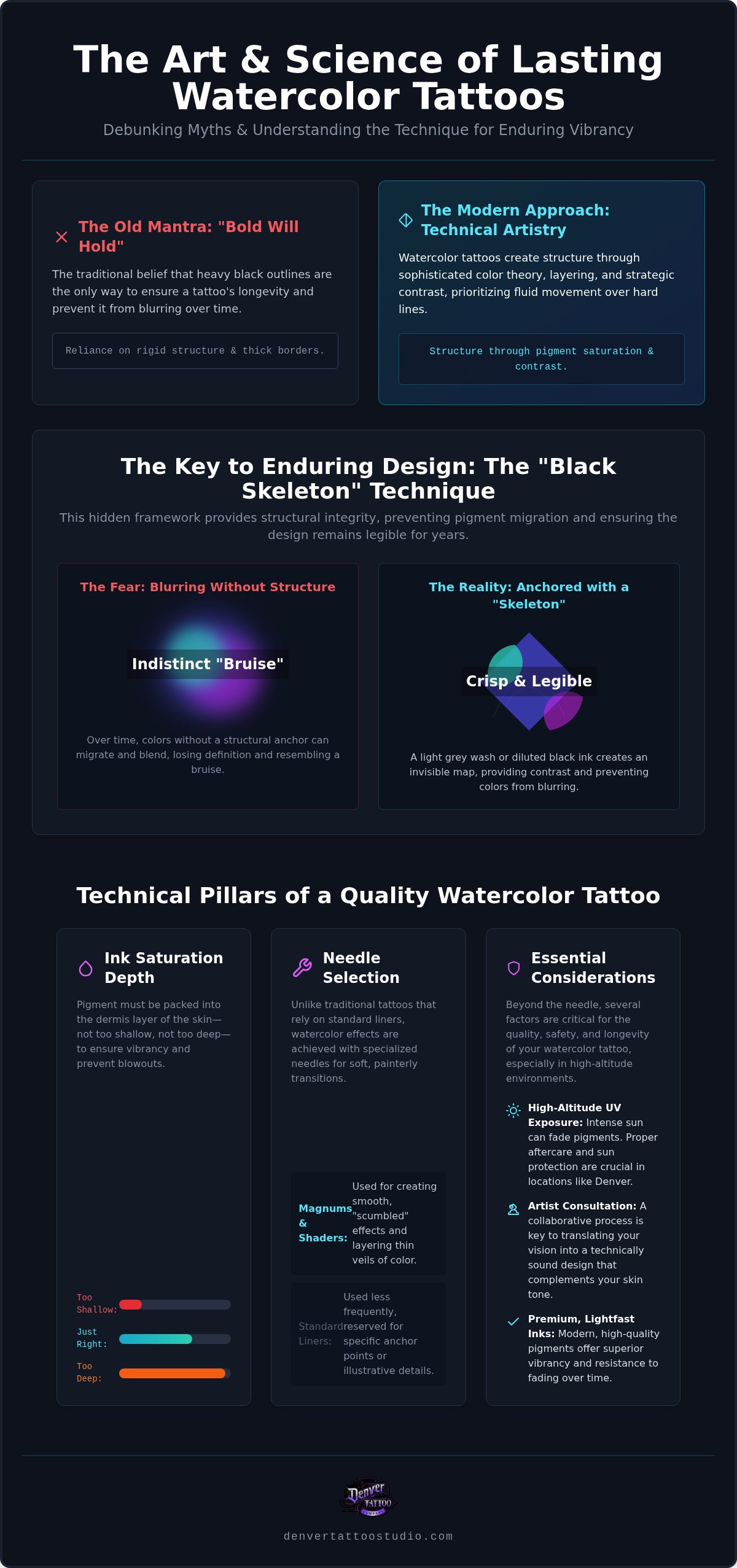
For decades, the industry relied on the "bold will hold" mantra. This philosophy suggested that heavy black outlines were the only way to ensure a tattoo's longevity. Watercolor art challenges this tradition. By utilizing sophisticated color theory and strategic layering, artists create structure without the need for thick, dark borders. You'll find two primary approaches in this category. Illustrative watercolor keeps a recognizable subject at its core, while abstract watercolor focuses entirely on the emotional interplay of vibrant pigments. Both styles require a master's eye for composition and skin anatomy.
The Painterly Aesthetic and Visual Flow
Replicating a "wet-on-wet" appearance on human skin is a complex technical feat. It requires an artist to understand how skin pigments layer and interact. True watercolor pieces use transparency to build depth, much like an artist would on paper. Negative space is equally important in these designs. By leaving specific areas of the skin untouched, the artist creates "light." This allows the colors to pop and prevents the piece from feeling muddy. This intentional use of the skin's natural tone ensures the design flows harmoniously with your body's unique contours.
Evolution from Trend to Technical Discipline
This style has come a long way since its experimental beginnings in the early 2000s. It has shifted from a fringe trend into a highly respected technical discipline. Modern ink technology has played a massive role in this shift. We now have access to premium, lightfast pigments that offer superior vibrancy and staying power. However, the tools are only as good as the hands that hold them. Formal art training is indispensable for this type of work. At Denver Tattoo Company, we draw on Jason Oz’s 20 plus years of experience to bridge the gap between fine art and technical tattooing. Every custom design starts with a collaborative consultation to ensure the aesthetic vision is supported by sound tattoo physics. This disciplined approach is what transforms a beautiful idea into a permanent, high-quality piece of art.
Technical Mastery: How Watercolor Tattoos Are Built to Last
Many people assume watercolor tattoos are prone to fading simply because they lack the thick, black borders of traditional Americana. While it's true that color pigments behave differently than black carbon, the longevity of a watercolor tattoo Denver clients receive depends entirely on technical execution. A master artisan doesn't just "paint" on the skin. They build a foundation that ensures the piece remains legible as the body naturally ages and the skin changes. This process requires a deep understanding of ink chemistry and how various pigments interact with the dermis.
Anchor Points and Contrast Management
One of the most effective ways to ensure a watercolor piece holds its shape is through the "Black Skeleton" or anchor technique. This involves using very light grey washes or diluted black ink to create a subtle map of the design. These lines are often invisible to the naked eye once the vibrant pigments are applied, yet they provide the necessary contrast to keep the design from looking like a bruise. An anchor technique serves as a structural necessity for ink longevity by providing a framework that prevents pigment migration over time. By balancing soft gradients with these darker anchor points, we ensure the eye can always distinguish the subject matter, even after years of sun exposure.
Ink Saturation and Needle Selection
Achieving those signature soft transitions requires a specific approach to needle selection and ink packing. While traditional styles might use a standard liner, watercolor often utilizes magnums and round shaders to create smooth, "scumbled" effects. Scumbling involves layering thin veils of color to mimic the transparency of actual paint. However, the artist must still pack the pigment deep enough into the dermis to ensure it stays. If the ink is too shallow, it will peel away during healing; too deep, and it will result in a blowout that ruins the delicate aesthetic.
Maintaining high standards for Tattoo Safety is paramount during this process, especially when working with the complex color blends required for a watercolor tattoo Denver. We use premium, high-load pigments that are specifically designed for maximum saturation and lightfastness. This technical precision is why we recommend a thorough tattoo consultation before beginning any custom project. It allows us to analyze your skin's unique canvas and plan a technical approach that prioritizes both artistic beauty and long-term permanence.
The Longevity Debate: Fading and High-Altitude Skin Care
"Do watercolor tattoos fade faster than traditional styles?" It's the most frequent question we hear. While all ink settles and softens over decades, the history of tattoos demonstrates that longevity is a partnership between the artist's technique and the client's lifestyle. In the Mile High City, this partnership is tested by environmental factors that artists in coastal regions rarely consider. A watercolor tattoo Denver residents wear must withstand intense solar radiation and a notably dry atmosphere. Understanding these variables allows you to protect your investment for years to come.
Protecting Pigment from Colorado Sun
At 5,280 feet, the atmosphere is thinner, providing less protection from ultraviolet (UV) radiation. This is a critical factor for watercolor art because the style relies on lighter, more transparent pigments. UV rays act as a catalyst that breaks down the chemical bonds of ink particles, causing them to dissipate and blur. For hikers and skiers in the Front Range, a high-quality SPF 50 or higher is non-negotiable. We often tell our clients that the sun is the primary enemy of vibrant color. If you spend your weekends on a 14er, keeping your art covered or heavily protected is the only way to maintain that "just-finished" glow.
Healing in a Semi-Arid Climate
Colorado's semi-arid climate presents a second challenge: moisture retention. During the initial healing phase, your skin needs to remain supple to prevent the ink from being pulled out during the peeling stage. We emphasize hydration from the inside out. Drinking plenty of water is just as important as topical ointments. When the air is this dry, your body can struggle to maintain the elastic barrier necessary for proper ink setting. If the skin becomes too brittle, you risk losing those delicate, painterly transitions that define the style.
Our recommended aftercare routine for a watercolor tattoo Denver involves a few disciplined steps:
- Wash the area with fragrance-free, antimicrobial soap twice daily.
- Apply a very thin layer of specialized ointment to prevent cracking.
- Avoid long soaks in hot tubs or pools for at least two weeks.
- Transition to a high-quality, unscented lotion once the initial peeling concludes.
The reality of "freshening up" color should be viewed as proactive maintenance rather than a repair. Even with perfect care, a small touch-up after several years can revive the luminosity of your piece. This ensures your custom art remains as striking as the day you left our studio in Englewood.
Designing Your Piece: Local Inspiration and Placement
Designing a watercolor tattoo Denver residents will love starts with a vision that embraces the style's inherent fluidity. Unlike traditional tattoos that rely on rigid outlines, watercolor pieces require a subject that benefits from soft edges and color bleeding. We begin by evaluating your skin's natural undertones. This step is vital because certain pigments may shift slightly once they settle under your specific skin tone. Selecting the right palette ensures the final result remains as vibrant as your initial concept.
After settling on a theme, we look at placement. We've already discussed the impact of the Colorado sun, so choosing an area that's easily protected is a smart long-term strategy. The collaborative sketch phase is where your "vibe" becomes a technical reality. We don't just hand you a finished drawing. We work together to adjust the "splatter" and "brushstroke" effects until they feel right for your body. This ensures the piece is a true reflection of your personality while maintaining its artistic integrity.
Colorado-Inspired Watercolor Themes
The local landscape offers endless inspiration for this aesthetic. The Rocky Mountain Columbine is a perfect candidate for watercolor. Its delicate petals allow for soft transitions between deep purples and crisp whites. If you prefer urban themes, an abstract Denver skyline with a "sunset" splatter effect can capture the city's unique light. Wildlife portraits also shine in this style. We can use painterly techniques to suggest the quick movement of a red fox or the flutter of a bird's wing. This gives the piece a sense of life that static lines often miss.
Placement and Body Flow
Successful watercolor art works with your anatomy rather than against it. The inner forearm and thigh are prime real estate for these designs. These areas provide a flat, stable canvas that allows colors to saturate evenly without the distortion found on joints. You'll want to avoid high-friction zones like elbows or knees. Since watercolor lacks the protective barrier of a thick black outline, constant rubbing can lead to premature wear. A well-placed splash of color can accentuate the natural muscle lines of your body, creating a sense of motion. If you're ready to start your journey, you can book one of our tattoo consultations to discuss your custom design and placement strategy.
The Denver Tattoo Company Experience: Custom Art in Englewood
Choosing the right studio for a watercolor tattoo Denver is just as important as the artwork itself. A clean, professional environment provides the necessary foundation for the meticulous color work this style requires. Unlike high-volume "flash" shops that prioritize turnover, our Englewood studio is a space of focus and dedication. Jason Oz leads our team with more than 20 years of experience, bringing a level of discipline that's rare in the industry. This veteran expertise ensures that every custom piece is approached with a deep understanding of skin physiology and artistic composition. We view our work as a collaborative creative process rather than a simple transaction.
The Professional Consultation Process
The process starts with a collaborative consultation to bridge the gap between your inspiration and a technically viable watercolor tattoo Denver piece. We encourage you to bring reference images, whether they're photos of the Rocky Mountains or abstract paintings, to help us understand your aesthetic. During this phase, we manage expectations regarding size and complexity. Because watercolor relies on soft gradients, the design needs enough physical space to prevent the pigments from merging into a single tone over time. We'll work together to refine the scale and placement, ensuring the final result is a custom piece that complements your body's natural flow. Booking a session at our Englewood studio means you'll have a clear roadmap for your art before the needle ever touches your skin.
Safety and Artistic Integrity
Artistic integrity is inseparable from technical safety. We maintain strict sterilization protocols, utilizing single-use equipment for every procedure to ensure your peace of mind. Our commitment to quality extends to the materials we use, specifically our selection of premium, lightfast pigments. These inks are chosen for their high saturation and their ability to remain vibrant despite the intense UV exposure common in Colorado. By using only the highest-grade materials, we address the common fear of color fading or blurring. We want your investment to remain a source of pride for decades. If you're ready to transform your vision into reality, you can Schedule your custom watercolor consultation at Denver Tattoo Company.
Elevating Your Vision into Permanent Art
A successful watercolor piece is more than just a collection of vibrant splatters and soft gradients. It's a technical achievement that relies on foundational anchor points and deep pigment saturation to withstand the test of time. By understanding the unique challenges of Colorado's high UV index and semi-arid climate, you can ensure your body art remains as crisp and legible as the day it was finished. The key is choosing a partner who values technical safety and artistic integrity over high-volume turnover.
At Denver Tattoo Company, we prioritize the collaborative nature of every project. Led by Jason Oz with 20 plus years of industry experience, our team operates within a clean, focused environment that meets hospital-grade sterilization standards. We specialize in custom, vibrant color work that respects your skin's unique anatomy and your personal aesthetic goals. When you're ready to start your journey toward a stunning watercolor tattoo Denver master artisans can provide, we're here to guide you through every technical and creative decision.
Book Your Custom Watercolor Consultation Today and discover the difference that veteran expertise makes in your next piece of body art. We look forward to helping you create something truly extraordinary.
Frequently Asked Questions
How much does a watercolor tattoo in Denver typically cost?
Pricing for a watercolor tattoo Denver artists create is generally determined by the complexity of the design and the total time required for saturation. While some studios charge by the piece, others utilize an hourly rate that reflects the artist's experience level. Because watercolor work involves intricate color blending and layering, these pieces often require more time than simple designs. Scheduling a consultation is the most accurate way to receive a specific estimate for your custom artwork.
Do watercolor tattoos hurt more than traditional tattoos?
The sensation of getting a watercolor tattoo is very similar to other styles, though the technique used for color blending can feel different. Traditional tattoos often involve bold lining, while watercolor relies more on scumbling or shading with magnum needles. Some clients find the repetitive layering of color to be slightly more sensitive than a single pass of a liner. However, the overall level of discomfort mostly depends on the tattoo's placement and your individual pain tolerance.
Can you do a watercolor tattoo over an old, faded tattoo?
Yes, watercolor techniques can be effectively used for cover-ups, provided the original tattoo is sufficiently faded. The fluid nature of the style allows an artist to mask old ink with vibrant gradients and organic shapes. However, dark or heavy black lines in the old piece may require a more illustrative approach with deeper pigments to ensure full coverage. We evaluate every cover-up individually during a consultation to determine if the watercolor aesthetic can successfully hide the previous work.
How do I choose the right colors for my skin tone?
Selecting the right palette involves analyzing your skin's natural undertones to ensure the pigments remain vibrant after healing. Cool undertones often pair beautifully with blues and purples, while warmer tones can make oranges and reds pop. A skilled artist will help you select high-contrast colors that prevent the design from looking muddy. This collaborative step is essential for creating a piece that maintains its luminosity and visual impact on your specific skin type.
Will my watercolor tattoo turn into a blurry blob in 10 years?
A technically sound watercolor tattoo won't lose its shape if it's built with proper structural integrity. We use the "black skeleton" or anchor technique to provide a subtle framework that prevents pigment migration over time. While all tattoos soften as they age, high-quality inks and deep saturation help the art remain legible. Proper aftercare and consistent sun protection are also vital factors in ensuring your piece doesn't blur into an unrecognizable shape.
How long does a watercolor tattoo session take at your Englewood shop?
Session length varies significantly based on the size and detail of your custom design. A small, simple piece might be completed in two to three hours, while a large-scale project could require multiple sessions of four to six hours each. The process of layering transparent colors and building gradients is methodical and shouldn't be rushed. We provide a time estimate during the consultation so you can plan your visit to our Englewood studio accordingly.
Can I get a watercolor tattoo as a walk-in?
While we do accept walk-in tattoos for simpler designs, watercolor work is usually best handled as a scheduled appointment. The custom nature of the style often requires preparation time for the artist to sketch and plan the color transitions. Booking a watercolor tattoo Denver in advance ensures that we can dedicate the necessary focus to your piece. If you have a specific vision in mind, a consultation is the best first step to guarantee the highest quality result.
What happens if my watercolor tattoo needs a touch-up later?
Touch-ups are a normal part of maintaining the longevity of vibrant color work. If you notice specific areas where the pigment has softened or settled unevenly after the initial healing, we can easily freshen up those sections. Proactive maintenance helps preserve the original luminosity of the piece. We recommend a check-in after the first few months to ensure the ink has set perfectly and to address any minor adjustments needed for long-term clarity.


