

What if the most meaningful mental health tattoo isn’t the symbol everyone recognizes, but one only you fully understand? A search for meaningful tattoos about mental health Denver often starts with a familiar image, such as a semicolon or lotus, then raises a more personal question: does it reflect your experience, or simply look familiar? It’s reasonable to want a design that feels authentic without sharing more than you intend. A tattoo can serve as a personal reminder, but it isn’t a treatment or a universal symbol.
This guide explores ways to shape personal meaning into clear, lasting artwork. You’ll find design directions, ways to balance symbolism with privacy, and practical considerations for keeping a concept legible as a tattoo. When you’re ready to develop an idea, a consultation at Art Fiend Club’s Englewood studio gives you a setting to discuss custom artwork with lead artist Jason Oz, who has more than 20 years of industry experience. Together, you can turn a starting point into a design that feels distinctly yours.
Key Takeaways
- Start with the experience or value you want your tattoo to represent, then choose imagery that feels personal rather than relying on a symbol’s common meaning.
- Compare words, recognizable symbols, and abstract imagery by how clearly each can express your idea as a tattoo.
- Think about visibility and placement as part of your design, especially if you want to keep the meaning private or share it selectively.
- For meaningful tattoos about mental health Denver, prepare a short explanation and visual references to guide a focused consultation and custom design.
- Denver Tattoo Company’s custom design process can help shape a personal concept into lasting artwork.
What makes a mental health tattoo meaningful to you?
A meaningful tattoo connects a symbol, phrase, or image to a story that matters to the person wearing it. That story may involve living with anxiety or depression, moving through recovery, building resilience, or learning self-acceptance. The design doesn’t need to explain the experience to anyone else. Its significance can be shared with loved ones, kept private, or understood only by its wearer.
It’s helpful to keep the role of body art clear: a tattoo may act as a personal reminder, but it doesn’t treat, diagnose, or prevent a mental health condition. Mental health is a broad subject shaped by many factors; Understanding Mental Health offers general background. A tattoo can mark a commitment or meaningful chapter, while support and care are separate needs.
Start with the feeling or value behind the tattoo
Before choosing an image, ask what you want the artwork to represent. Is it hope, patience, connection, perseverance, or a value you want to carry forward? Write down a few words, memories, or small details connected to that idea. This gives you a personal starting point without assuming one symbol carries the same meaning for everyone.
Social media interpretations can provide inspiration, but they don’t have to define your design. A familiar image may feel right because of your own story, or it may seem too generic. Let your meaning anchor the concept, then build the visual around it.
Choose how much of your story to share
Some people prefer a discreet personal symbol, while others choose a message that friends or the wider community can recognize. Consider whether the design might invite questions from coworkers, family, or strangers. Visibility is a personal decision, and no placement is right for everyone.
You’re not obligated to explain a tattoo. You could prepare a simple response, such as “It’s a personal reminder,” or keep the story to yourself. The design can be meaningful even when its full context stays private.
For meaningful tattoos about mental health Denver residents are considering, separate the reason for the tattoo from the first image that comes to mind. That pause can make the concept more specific. Rather than choosing a symbol simply because it is widely linked to resilience, focus on a quality, memory, or private reference that reflects what resilience means in your life.
Then decide what the design needs to communicate visually. A small image can hold a private association, while a short phrase may make its intent more apparent. Neither approach is inherently more meaningful. Choose a direction that reflects your values, feels comfortable to wear, and can be developed into clear artwork. A short note about the meaning can help you explain the idea during a custom tattoo consultation without sharing more of your story than you want.
Mental health tattoo ideas: symbols, words, and personal imagery
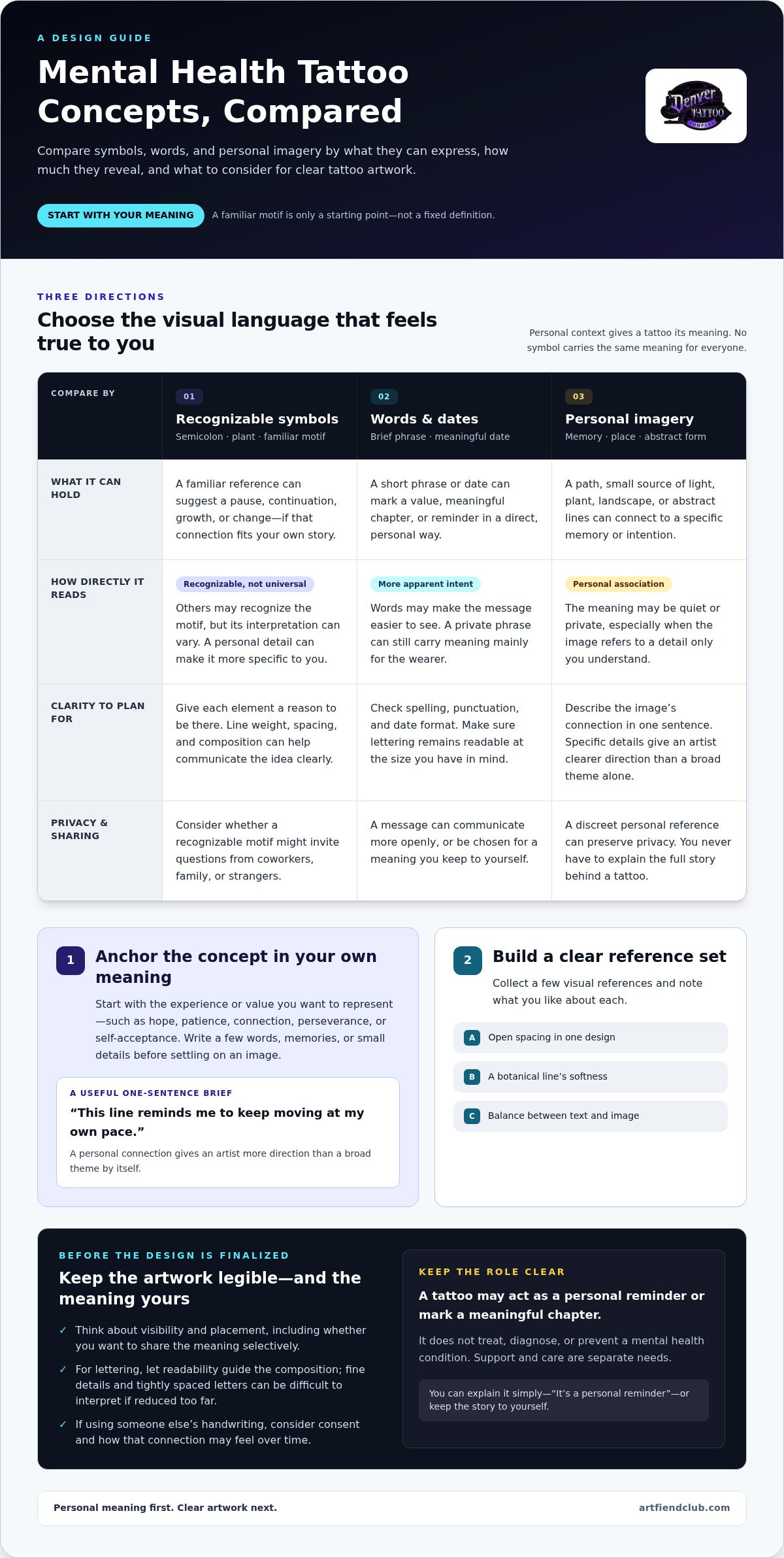
A useful design can begin with a familiar symbol, a few words, or an image drawn from an ordinary personal memory. Adapt the starting point so it reflects the wearer’s experience, rather than treating any motif as a universal statement about mental health. Personal context gives a tattoo its meaning; trend status alone can’t make a symbol yours.
As you explore meaningful tattoos about mental health Denver, think in terms of visual ingredients rather than ready-made answers. Punctuation might suggest a pause or continuation; a plant might connect to growth, change, or a place that helps you feel grounded. A path, a small source of light, or abstract lines can also hold significance through a specific memory or intention. Treat these as prompts for original artwork, not fixed definitions.
Use symbols as starting points, not fixed definitions
A semicolon is one possible reference, but its interpretation varies. You might keep it simple, combine it with a detail from your life, or decide another image feels more accurate. Nature-inspired imagery is just as flexible: a plant may represent change for one person and a meaningful landscape for another. Abstract curves, intersecting lines, or geometric forms offer a quieter option when recognizable imagery feels too direct.
Try describing the image’s personal connection in one sentence. “This line reminds me to keep moving at my own pace” gives an artist more direction than “I want something about resilience.” In a custom design, line weight, spacing, and composition can help carry that idea clearly. The goal isn’t to make a symbol universally understood; it’s to give each detail a reason to be there.
Make words and dates feel personal
A brief phrase, meaningful date, or handwriting-inspired detail can make a concept more specific. Before committing, verify spelling, punctuation, and date format. Then consider whether the lettering will remain readable at the size you have in mind. Fine details and tightly spaced letters can be difficult to interpret if the design is reduced too far, so let clarity guide the composition.
Handwriting can add a personal quality, but consider whose writing it is and whether using it feels appropriate. If it belongs to someone else, reflect on their consent and how that connection may feel over time. You can also use handwriting as a reference for the overall character of the lettering without copying it exactly.
To develop a concept, collect a few references and note what you like about each: perhaps the open spacing in one design, the softness of a botanical line in another, or the balance between text and image. A custom tattoo consultation gives you a setting to discuss those preferences and shape them into a cohesive design. This helps distinguish elements that serve your meaning from details included only because they’re popular.
How to compare mental health tattoo concepts before choosing one
Once you have a few possible concepts, compare what each means to you with how clearly it can work as a tattoo. A design may feel powerful in a sketch but become hard to read at a smaller size, or communicate more openly than you want. For meaningful tattoos about mental health Denver residents are considering, the right choice depends on your priorities, not a universal rule.
Compare design directions by meaning and visibility
Use this comparison to identify trade-offs before settling on a direction. “How immediately it reads” refers to the image’s visual impression, not whether someone else can know your personal story.
| Design direction | Personal interpretation | How immediately it reads | Privacy considerations |
|---|---|---|---|
| Illustrative motif | Can connect an object, natural form, or scene to a personal memory or value. | Often visually recognizable, though its specific meaning may not be obvious. | A familiar image may invite questions, while a distinctive detail can make its story more personal. |
| Lettering | Can preserve a phrase, date, or words that carry direct significance. | Usually communicates more plainly, depending on the wording and lettering. | Visible text may prompt questions or reveal more than a symbolic image. |
| Abstract art | Can hold meaning through shape, movement, or an association known mainly to you. | May be less immediately interpreted by others. | Can feel private, although people may still ask what it represents. |
Check clarity at the design stage. Fine lines, tiny details, and long wording may need to be simplified or resized so the finished concept remains legible. A tattoo artist can assess how the elements work together and adapt the composition without losing the idea behind it.
Balance permanence with changing personal meaning
A tattoo can mark an important period, value, or intention, but your understanding of that experience may change over time. Ask yourself whether the concept could still feel appropriate if your circumstances or perspective shift. It doesn’t need to predict your future; it should feel considered enough to carry forward.
Keep a draft of the idea, including the wording, visual references, and a short note about what you want it to express. Revisit it later and notice whether it still feels right, or whether you want to adjust its scale, detail, or message. Exploring custom tattoo designs in Denver can help you understand how an individual concept develops into finished artwork.
One distinction deserves care: a tattoo can mark meaning, but it doesn’t replace therapy, medication, or crisis support. Treat the design as body art, not as treatment or a substitute for care. That boundary leaves room for a meaningful piece while keeping support needs separate from the tattoo decision.
Planning a mental health tattoo in Denver: from idea to consultation
A thoughtful plan helps turn a personal idea into artwork that’s clear, comfortable to wear, and suited to your preferences. Work through the concept in stages: define what you want it to represent, gather visual references, consider placement, then bring those details to a tattoo consultation. You don’t need a complete design before the conversation. A clear starting point gives the artist room to refine the composition with you.
Prepare references without copying another tattoo
Collect images for qualities you like, such as a particular line quality, mood, balance, or use of space. Treat them as visual direction rather than templates to reproduce. Combining elements from several references can help an artist develop original custom work that reflects your story instead of duplicating someone else’s tattoo.
Before the consultation, write a short note covering three things: the idea’s personal meaning, details you’d like included, and anything you’d prefer to avoid. For example, you might want a calm, understated design that includes a reference to a meaningful place but avoids lettering. This gives the artist useful creative boundaries without requiring you to share more personal history than you’re comfortable discussing.
Bring a concise explanation and a manageable set of references. If you’re still preparing, these questions for a tattoo consultation can help you feel ready for the conversation without needing to plan every detail in advance.
Think through placement and the Denver-area appointment
Placement is part of the design, not just a final choice. Consider how visible you want the tattoo to be, how it may sit under everyday clothing, and how movement in that area could affect the composition. A long, narrow concept and a compact image may suit different areas, so share your placement preferences early. The artist can help adjust scale and layout for the chosen area.
Denver Tattoo Company is an Englewood studio serving clients in Denver, Lakewood, Highlands Ranch, and Littleton. At a consultation, you can discuss your references, intended meaning, and placement as one connected design brief. The studio emphasizes single-use sterilized equipment and premium inks; its overview of safe tattoo studio practices offers added context on hygiene.
For meaningful tattoos about mental health Denver clients want to develop into personal artwork, a consultation provides space to work through design choices collaboratively. Bring your notes and references, then schedule a tattoo consultation to discuss how the concept can become a considered, cohesive design.
Create meaningful mental health tattoo art with Denver Tattoo Company
A personal idea can become lasting tattoo artwork through a focused conversation about meaning, imagery, and design. Denver Tattoo Company is a tattoo-only studio in Englewood serving Denver-area clients. Lead artist Jason Oz brings more than 20 years of tattoo industry experience to the craft. He works with you on the visual concept, composition, and tattoo details, not on interpreting or treating mental health conditions.
That distinction matters. A tattoo can represent a personal value or experience, but it isn’t a substitute for mental health care. The design process is about creating considered body art that reflects what you choose to share.
Turn a personal idea into custom artwork
During a consultation, describe the idea in your own words, show preferred imagery, and explain any boundaries around what the design should reveal. You might share a phrase you want represented without including it literally, or point to visual references that capture a mood or composition. A clear explanation gives the artist a useful starting point while leaving room to refine the artwork together.
Custom design is especially useful when your concept combines personal meaning with practical visual choices. The artist can help consider how elements relate, how the composition reads, and which details support the idea. You decide what the tattoo means; the artist focuses on translating your direction into a cohesive design. For another perspective on that process, explore custom tattoo design in Denver.
Take a considered next step
When you feel ready to discuss your idea, bring a few visual references and any questions you’ve noted. You don’t need to arrive with finished artwork. A short explanation of the concept, your preferences, and what you’d like kept private can help make the conversation specific and comfortable.
A scheduled consultation is for discussing personalized artwork and developing a concept. Walk-in tattoo visits are a separate option if you’re seeking a tattoo visit without beginning with the same custom-design discussion. Choose the starting point that fits whether you’re ready to proceed with a tattoo or want to work through a personal concept first.
Denver Tattoo Company emphasizes single-use sterilized equipment and premium inks as part of its studio standards. These details speak to the studio’s attention to the tattoo process, without making a guarantee about outcomes. If your idea feels ready for a conversation, plan a tattoo consultation and bring the references or notes that help express what you have in mind.
Give your idea room to take shape
A tattoo concept doesn’t have to arrive fully formed. You can begin with a feeling, a phrase, or a small visual detail and let the final composition develop through thoughtful discussion. The important part is that the finished piece feels considered and true to you, not like a symbol chosen to meet someone else’s expectations.
If you’re exploring meaningful tattoos about mental health Denver, give yourself permission to move at a pace that feels right. Keep a note of what you want the artwork to hold onto, and stay open to adjustments that make the design clearer or more personal. The next step may simply be turning a private thought into a conversation about art.
When you’re ready to explore that possibility, plan a thoughtful tattoo consultation. Bring your idea as it is today, even if it’s still taking shape. A considered beginning can lead to artwork that feels distinctly yours.
Frequently Asked Questions
Can a tattoo help with mental health?
A tattoo can’t treat or prevent a mental health condition, but its personal meaning may make it a valued reminder of a commitment, relationship, or important moment. That’s different from clinical care. If you’re looking for help with symptoms, consider speaking with a qualified mental health professional. A tattoo can be part of how you express your story, but it shouldn’t replace therapy, medication, or crisis support.
What is a meaningful symbol for mental health?
There isn’t one symbol that means the same thing to everyone. A semicolon, a plant, a path, or an abstract shape might represent something personal, but its significance depends on the wearer’s own associations. For example, a particular leaf could recall time spent with someone supportive. Start with what you want the image to remind you of, then consider whether it genuinely fits your meaning.
Should I get a semicolon tattoo for mental health?
Consider a semicolon if its commonly recognized association feels relevant to you, but don’t choose it just because it’s familiar or popular. Ask whether you’d still value the mark if other people interpreted it differently or asked about it. You could keep the punctuation simple, incorporate a personal detail, or explore another concept. Since a tattoo is permanent, take time to decide whether the symbol feels right for your own story.
How do I choose a mental health tattoo design?
Begin with the idea you want the tattoo to hold, then sketch a few options that express it in different ways. Compare them at the approximate size you’re considering, not only on a screen: small lettering or intricate shapes may lose clarity. Note which details are essential and which are flexible. A tattoo artist can help refine the composition so it reads clearly while staying connected to your intention.
Can a mental health tattoo be discreet?
Yes. A design can use a small scale, a less recognizable image, or a placement usually covered by clothing, depending on your preferences. Think about when you’d want it visible, such as at work, with family, or only in private. Discretion isn’t guaranteed by a particular symbol or location, so consider how the design may appear in everyday situations and how you’d feel if someone noticed it.
Where can I get a meaningful mental health tattoo near Denver?
Denver Tattoo Company is a tattoo-only studio in Englewood serving Denver-area clients, including people from Denver, Lakewood, Highlands Ranch, and Littleton. You can schedule a consultation to discuss personalized artwork or visit for a walk-in tattoo. Bring a reference or a few notes about your concept, and the artist can focus on developing the tattoo design with you. The studio emphasizes single-use sterilized equipment and premium inks.


