
A geometric tattoo is more than just a design; it's a permanent commitment to mathematical perfection on a living, breathing canvas. You've likely spent hours scrolling through mandalas and sacred patterns, captivated by the flawless symmetry, yet worried that a single shaky line or poor placement could turn your vision into a distorted mess. It's a valid concern because the human body isn't a flat sheet of paper, and what looks perfect on a screen can easily warp when it's applied to skin.
Finding the right artist for a geometric tattoo Denver can feel daunting when you're looking for surgical precision and a deep understanding of sacred geometry. We're here to guide you through the entire process, ensuring you feel confident in your choice and the longevity of your art. You'll learn how to evaluate an artist's technical portfolio, how to plan for designs that wrap correctly around your muscles, and what to expect during a collaborative consultation. This guide provides a clear roadmap to achieving a perfectly symmetrical, long-lasting piece of art that honors the complexity of the craft.
Key Takeaways
- Grasp the "zero margin for error" rule that makes technical precision the most critical factor in a successful geometric piece.
- Learn how master artists account for skin stretch and joint movement to keep your symmetrical design from warping on a 3D canvas.
- Identify the best aesthetic for your geometric tattoo Denver by comparing the spiritual centering of mandalas with the depth of precision dotwork.
- Discover how to audit an artist’s portfolio for long-term line integrity by looking at specific indicators in both fresh and healed photos.
- Master the preparation and session-management techniques that help you stay still and ensure your lines remain crisp throughout the process.
What Defines a High-Quality Geometric Tattoo in Denver?
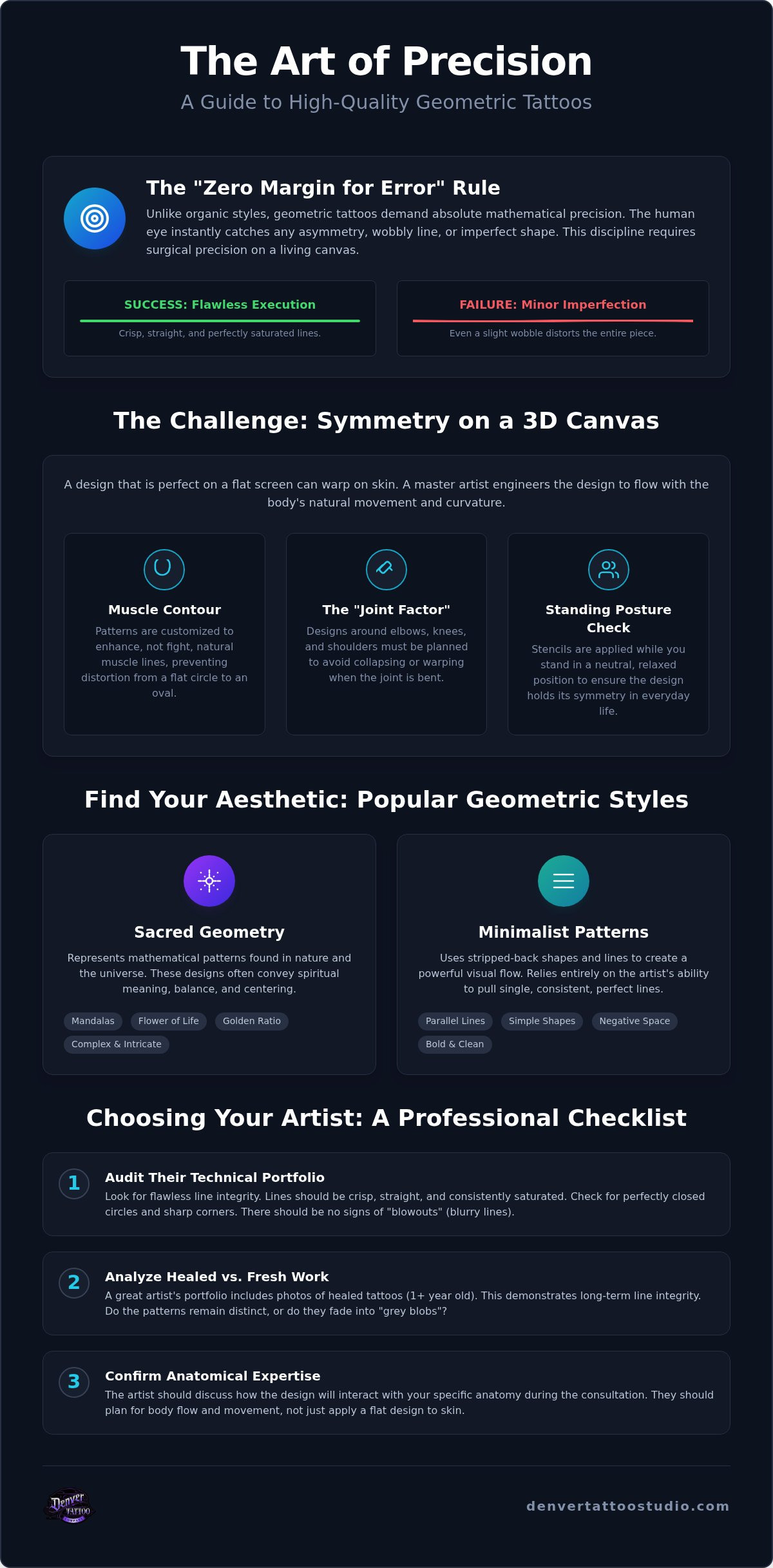
Geometric tattoos rely on mathematical shapes, lines, and repeating patterns to build complex visual structures. Unlike organic styles that can hide small flaws in texture or shading, this discipline demands a "Zero Margin for Error." If a straight line wobbles or a circle doesn't close perfectly, the human eye catches the asymmetry instantly. Achieving a high-quality geometric tattoo Denver requires an artist who views the skin as a precise grid rather than just a canvas.
Contrast is the secret to a design that remains legible for decades. By balancing heavy blackwork with intentional negative space, the pattern remains distinct even as the skin ages. Proper ink saturation is vital; without it, intricate patterns eventually fade into "grey blobs" that lose their mathematical sharpness. A professional approach ensures that the depth of the black ink is consistent across the entire piece, preventing patchy healing.
The Evolution of Modern Geometry in Colorado Tattoo Culture
The Denver art community has always had a deep connection to the natural world, which has fueled the local obsession with sacred geometry and mandalas. Over the last decade, the scene has moved away from thick, traditional borders toward architectural and mathematical influences. This evolution is particularly visible in Lakewood and Englewood, where "Fine Line" geometry is now a staple. Executing these pieces requires a master artisan with a steady hand, such as Jason Oz, whose 20+ years of experience ensures that every geometric tattoo Denver client receives a piece that remains sharp for a lifetime.
Sacred Geometry vs. Minimalist Patterns
Sacred geometry is the visual representation of mathematical patterns found in nature. These designs, such as the Flower of Life or Metatron’s Cube, aren't just aesthetic choices; they represent the Golden Ratio and the underlying order of the universe. This style often finds its roots in the ancient tradition of Sacred Geometry in Tattoos, which uses patterns to convey spiritual protection and centering. Many enthusiasts choose these patterns to create a sense of balance and symmetry that mirrors the complexity of the natural world.
In contrast, minimalist patterns use stripped-back shapes to create a powerful visual flow. Instead of filling the skin with complex mandalas, a minimalist approach might use a single series of parallel lines or a perfectly centered triangle. These designs rely entirely on the artist's ability to pull a single, consistent line without hesitation. Because there's no room to hide mistakes, the collaborative consultation process becomes vital for mapping out how these simple shapes will interact with your specific anatomy.
The Technical Challenge: Symmetry on a 3D Biological Canvas
Tattooing a perfect square on a flat piece of paper is a simple task of geometry. Applying that same square onto a human shoulder involves a complex understanding of biological physics. Every time you move your arm, your skin stretches and twists, which can easily distort a symmetrical pattern. This is why a high-quality geometric tattoo Denver relies on an artist who knows how to compensate for these shifts before the needle even touches the skin. It isn't just about drawing; it's about engineering a design that survives movement.
Jason Oz leverages over 20 years of experience to act as a steady hand for these high-stakes sessions. He accounts for the "Joint Factor," which is the way patterns must be placed around elbows, knees, and shoulders to prevent them from collapsing when you bend. While digital stenciling technology provides a mathematically perfect starting point, the final application requires a human eye to adjust for individual anatomy. If you're ready to see how a custom design can fit your unique anatomy, consider booking one of our tattoo consultations to discuss your vision.
Designing for Body Flow and Anatomy
A circle that looks perfect on a flat stencil can quickly look like an oval once it's placed on a forearm. This happens because the skin wraps around the muscle, creating a three-dimensional curve. For clients in Highlands Ranch or the wider Denver area, patterns are customized to enhance natural muscle contours rather than fight against them. The most critical part of this process is the "standing posture" check. We apply the stencil while you're standing in a neutral, relaxed position to ensure the symmetry holds true during your everyday life, not just while you're sitting in the chair. Finding an expert for a geometric tattoo Denver means finding someone who respects the physics of the skin as much as the art itself.
Preventing Blowouts and Line Migration
Precision in geometric work depends heavily on the science of needle depth. If the needle goes too deep, the ink spreads into the surrounding tissue, causing a "blowout" that ruins the sharp edge of a line. We use premium pigments that are designed to hold their edge for years, maintaining the integrity of the work. Line migration is a natural process that must be accounted for in the initial design spacing. By leaving just the right amount of "breathing room" between parallel lines, we prevent them from merging over time. Adhering to professional standards for Tattoo Safety and Healing ensures that your skin remains healthy enough to support these crisp, permanent details.
Popular Geometric Styles Found in Englewood and Denver Studios
Denver's tattoo scene is a hub for diverse aesthetic expressions, ranging from ancient spiritual symbols to modern architectural designs. Choosing a geometric tattoo Denver often starts with identifying which sub-genre resonates with your personal style and the story you want to tell. From the spiritual depth of mandalas to the stark impact of heavy blackwork, each style requires a specific technical approach to ensure the final piece remains a cohesive work of art. Understanding these Modern Geometric Tattoo Styles helps you collaborate more effectively during your design consultation.
Dotwork and pointillism use thousands of tiny ink deposits to build gradients and depth, offering a softer alternative to solid lines. This technique is particularly effective for creating 3D effects within a flat pattern. Blackwork geometry, on the other hand, utilizes high-contrast, bold shapes that dominate the visual field, often using large areas of saturated ink to make the skin's natural tone pop. For those looking to cover large areas, fractal art provides infinite patterns that scale perfectly across full sleeves or leg pieces, creating a sense of movement and complexity that never seems to end.
Mandalas and Spiritual Geometry
Mandalas represent symmetry and spiritual centering, making them a popular choice for central body placements like the sternum or upper back. These locations provide a broad, relatively flat surface that allows the design to radiate outward without excessive warping. Many clients choose to integrate organic floral elements with rigid geometric structures to create a balance between nature and mathematics. The process for these pieces is often meditative, especially during long sessions of intricate dotwork that require both the artist and client to maintain a steady, focused rhythm. Because these designs are often deeply personal, a custom design process is essential to ensure the symbolism aligns with your intentions.
Mathematical and Architectural Patterns
For enthusiasts of precision, architectural patterns like tessellation create a seamless fabric of interlocking shapes across the skin. This style relies on perfect repetition to achieve its effect, demanding an artist who can maintain consistency over several hours. Some artists use advanced 3D shading techniques to create optical illusions, making flat geometric shapes appear to "lift" off the body or recede into the skin. Alternatively, minimalist line-work focuses on the beauty of a single, perfect thread of ink. This "less is more" approach highlights the artist's technical control, as there are no shadows or textures to hide a shaky hand. When seeking a geometric tattoo Denver, look for an artist whose portfolio demonstrates this level of unwavering line integrity.
Choosing Your Denver Geometric Artist: A Professional Checklist
Selecting an artist for a geometric tattoo Denver requires a more analytical approach than choosing one for traditional or illustrative work. While social media provides a curated look at an artist's best days, you need to dig deeper into technical execution to ensure your piece stands the test of time. A master artisan doesn't just show you a pretty picture; they demonstrate the discipline of their craft through every line and intersection.
- Step 1: Zoom in on portfolio photos. Look specifically at where lines meet and where they begin. High-quality work shows no "shaky" starts or inconsistent line weights. Every thread of ink should maintain the same thickness from start to finish.
- Step 2: Demand healed photos. Geometric work looks its sharpest on day one, but the real test happens after six months. Healed photos reveal if the artist's needle depth was consistent enough to prevent blurring or fading as the skin recovered.
- Step 3: Evaluate sterilization standards. Precision requires a focused, clean environment. Ensure the studio adheres to strict safety protocols, using only single-use sterilized equipment to protect both the art and your health.
- Step 4: Discuss the wrap and flow. A great artist will explain how your design will interact with your muscles. They should be able to visualize how a flat pattern translates to your 3D body before the needle ever touches you.
What to Ask During Your Consultation
The consultation is your opportunity to gauge the artist's technical depth. Ask specifically how they handle symmetry on the body part you've chosen, as some areas like the ribs or inner arm are much more difficult to keep straight than the outer thigh. Inquire about their process for creating and applying the digital stencil to ensure mathematical accuracy. Finally, ask to see healed examples of their fine-line or dotwork. This transparency builds the trust necessary for a collaborative creative process.
The Denver Tattoo Company Difference
At Denver Tattoo Company, we provide the steady hand necessary for high-stakes precision work. Jason Oz brings over 20 years of industry experience to every session, offering a level of technical mastery that's rare in the modern landscape. We prioritize your experience by maintaining a clean, focused, and professional environment where the craft is taken seriously. Our commitment to using single-use sterilized equipment ensures that your safety is never a secondary concern. Conveniently located in Englewood, we offer easy access for clients from Littleton, Lakewood, and the surrounding metro area. If you're ready to begin your project, you can schedule a consultation to discuss your custom design with an expert.
Preparing for and Healing Your Geometric Masterpiece
The success of your geometric tattoo Denver isn't just determined in the studio; it begins weeks before your appointment. Healthy, hydrated skin is the best canvas for precision work, as it allows the needle to deposit ink smoothly without excessive resistance or trauma. We recommend starting a consistent moisturizing routine at least two weeks before your session. This preparation ensures that your skin is supple and resilient, which is particularly important for the fine-line work and intricate dotwork that define this style. Drink plenty of water and avoid sun exposure on the target area to ensure the tissue is in peak condition for the needle.
During the session, your primary responsibility is to remain as still as possible. Geometric art leaves no room for accidental movement. Even a slight flinch can disrupt a mathematical pattern that has been meticulously mapped out to fit your anatomy. We encourage clients to prepare for long sessions by eating a full meal beforehand and staying hydrated. Taking small, planned breaks allows both you and the artist to maintain the high level of focus required for a precise application. This collaborative discipline is what ensures the final piece matches the digital stencil perfectly.
The First 48 Hours: Protecting the Lines
The initial healing phase is critical for preserving the integrity of your lines. Scabbing is the primary enemy of geometric work because as a scab forms and eventually falls off, it can pull pigment out of the skin. This results in gaps or "breaks" in your pattern that ruin the symmetry. To prevent this, use gentle washing techniques with unscented, antimicrobial soap and lukewarm water. Pat the area dry with a clean paper towel rather than rubbing it with a cloth. When applying aftercare products, remember that "less is more." A thin, breathable layer of ointment is all you need; over-applying can suffocate the skin and lead to irritation that compromises the crispness of your lines. Identifying signs of healthy healing, such as light flaking, is part of being a responsible collector of art.
Long-Term Maintenance in the Mile High City
Living in Colorado presents unique challenges for tattoo longevity. The high altitude and intense UV exposure can cause ink to break down and lines to blur much faster than at sea level. The Denver sun is the absolute enemy of geometric ink. High-SPF sunscreen is your most effective tool for preventing "line migration" and ensuring the high-contrast blackwork and negative space remain distinct for decades. Over time, even the most well-maintained tattoos may need a "sharpening" session. If you notice your lines losing their original punch after several years, a minor touch-up can restore the mathematical perfection of the piece. If you're ready to start your project, Book a consultation with Denver Tattoo Company today.
Realizing Your Vision with Precision
Achieving a flawless geometric tattoo Denver requires a perfect alignment of technical skill, anatomical understanding, and diligent aftercare. You've learned that successful geometry depends on an artist who treats your skin as a three-dimensional landscape, ensuring that every line remains symmetrical even during movement. By choosing a professional who prioritizes healed results over social media filters, you ensure your investment remains a crisp masterpiece for years to come.
At Denver Tattoo Company, we bridge the gap between complex mathematical theory and permanent body art. Jason Oz uses over 20 years of professional experience to guide you through a custom collaborative design process, ensuring your vision is realized with surgical precision. Our commitment to single-use sterilized equipment and a clean, focused environment provides the peace of mind you need for such high-stakes work.
If you're ready to transform your ideas into a mathematically precise reality, the next step is a professional conversation. Schedule your geometric tattoo consultation with Jason Oz today to discuss your placement and design. We look forward to helping you wear your story with absolute confidence.
Frequently Asked Questions
How long does a geometric tattoo take compared to other styles?
A geometric piece often takes longer than traditional or illustrative styles due to the meticulous stenciling and technical precision required. While a basic design might be completed in a few hours, complex patterns involve significant setup time to ensure mathematical accuracy. The artist must work slowly to maintain consistent line weights across the entire design. This deliberate pace ensures that every intersection is perfect and every line remains unwavering.
Do geometric tattoos hurt more because of the precision required?
The pain level isn't necessarily higher, but the sensation can be different because the artist often uses single needles or small groupings for fine lines. These sessions require you to stay perfectly still for extended periods, which can lead to physical fatigue. Because the work is so focused on specific areas to maintain symmetry, the repetitive motion may feel more intense than a style with broader, faster shading.
Can a geometric tattoo be covered up or reworked later?
Cover-ups for geometric work are challenging because the style relies on high contrast and open negative space. Strong, dark lines are difficult to hide without using heavy blackwork or very dense designs. If you're looking to rework an existing piece, it's often better to integrate the old lines into a new, more complex pattern. We recommend a consultation to evaluate the specific design and skin condition before committing to a change.
What is the best placement for a symmetrical geometric piece?
The best placement for a symmetrical geometric tattoo Denver is on relatively flat, stable surfaces such as the upper back, chest, or outer thigh. These areas provide a broader canvas that minimizes warping when you move. While joints like elbows and knees are popular, they require advanced engineering to prevent the pattern from collapsing. Choosing a stable area ensures the mathematical integrity of the design remains intact over time.
How much does a geometric tattoo cost in Denver?
Pricing for a geometric tattoo Denver varies based on the complexity of the pattern, the size of the piece, and the artist's experience level. Because this style requires a "zero margin for error" approach, it often involves longer sessions than simpler designs. Most professional studios in the metro area provide quotes based on an hourly rate or a flat day rate for larger projects. A consultation is the most accurate way to receive a specific estimate.
Why do lines in geometric tattoos sometimes look thicker after they heal?
It's natural for ink to settle and spread slightly over time, a process known as line migration. In geometric work, even a microscopic spread can make lines appear thicker than they did on the day of the appointment. A master artisan accounts for this by leaving specific "breathing room" between parallel lines. Proper aftercare and sun protection are also vital to preventing the ink from blurring or expanding prematurely as it settles.
Can you do geometric tattoos in color, or is black ink better?
While black ink is the standard for geometric work due to its high contrast and longevity, color is certainly an option. Vibrant pigments can be used to highlight specific patterns or create a 3D effect within the geometry. However, black ink tends to hold its sharp edges better over several decades. If you choose color, we suggest using it as an accent within a strong black framework to maintain the design's structural clarity.
Is it possible to get a geometric walk-in tattoo at your Englewood shop?
We do offer walk-in tattoos at our Englewood studio for simpler, smaller geometric designs that don't require extensive custom mapping. However, complex patterns and large-scale sacred geometry require a collaborative consultation process and custom design time. This allows us to map the art precisely to your anatomy. For anything involving intricate symmetry or full-day sessions, booking an appointment ensures the artist has the necessary time to prepare your mathematically perfect stencil.


