
The most expensive tattoo you'll ever buy isn't the one with the highest price tag; it's the one you eventually have to pay to get fixed or covered. When you start searching for how much do tattoos cost in Denver, you're likely met with a frustrating range of vague estimates and "it depends" answers. It’s understandable to feel a bit of anxiety about hidden fees or surprise costs when you're planning a permanent addition to your skin. You want a fair price, but you also want the peace of mind that comes with a sterile environment and a master artisan's steady hand.
We believe that transparency is just as vital as artistic integrity. This 2026 guide will help you understand the local tattoo market with total confidence by breaking down exactly how professional studios structure their fees. We'll explore the differences between hourly rates and flat fees, explain why a shop minimum is actually a guarantee of your safety, and help you build a realistic budget for your specific design idea. By the end, you'll know how to spot the difference between a high-value investment and a risky bargain.
Key Takeaways
- Learn how the local economy and artist expertise set the standard for how much do tattoos cost in Denver, including the shift toward hourly rates for custom work.
- Understand why design complexity and color choice often impact your final quote more than the physical size of the piece.
- Gain a clear roadmap for budgeting by reviewing current benchmarks for different tattoo sizes and the logic behind professional deposit policies.
- Discover how premium sterilization standards and high-grade materials protect your health and ensure the longevity of your investment.
- Build the confidence to navigate your next consultation as a collaborative partner with a master artisan.
Understanding the Denver Tattoo Market: Why Prices Vary
Denver's cultural evolution has transformed it into a premier destination for body art. As the city's arts scene continues to flourish, the demand for high-caliber work has naturally increased. This growth influences how much do tattoos cost in Denver, as top-tier studios must balance rising operational costs with the need for specialized talent. Beyond simple economics, the history and cultural significance of tattoos have evolved, leading modern clients to view their ink as a lifelong investment rather than an impulsive purchase. 2026 pricing reflects this shift toward quality, where the focus remains on artistic integrity and long-term results.
Choosing a reputable studio in Englewood means you're paying for more than just ink. You're investing in a controlled, professional environment. Modern professional pricing reflects significant advancements in pigment stability and medical-grade sterilization technology. This distinguishes established studios from unlicensed operators who work without oversight. A professional quote accounts for single-use equipment and premium inks that ensure your piece remains vibrant for decades. It's a commitment to safety that protects both the artist and the individual.
The Role of Artist Experience
Experience is one of the most significant variables in pricing. A veteran artist like Jason Oz, with over 20 years in the industry, brings a level of technical precision that an apprentice hasn't yet mastered. While a senior artist's hourly rate might be higher, they often possess a high efficiency factor. They can execute complex lines and smooth shading faster than a less experienced counterpart. This means you often receive a superior result in fewer hours. Specialized styles, particularly realism, require a deep understanding of light and shadow, which justifies a premium for the artist's specific expertise and years of dedicated study.
Studio Location and Professional Standards
Where a studio is located within the Denver metro area also plays a part in the pricing structure. Studios in downtown Denver often face higher overhead, which can be reflected in their rates. However, professional studios in Englewood, Highlands Ranch, or Littleton maintain consistent standards to provide a focused, high-end experience. A major portion of your investment goes toward the cost of clean. This includes the rigorous sterilization protocols and the high-quality, single-use tools required to guarantee your safety. When you see a shop minimum, it's a reflection of the fixed costs involved in setting up a sterile field for even the smallest design.
Hourly Rates vs. Flat Fees: How Denver Artists Charge
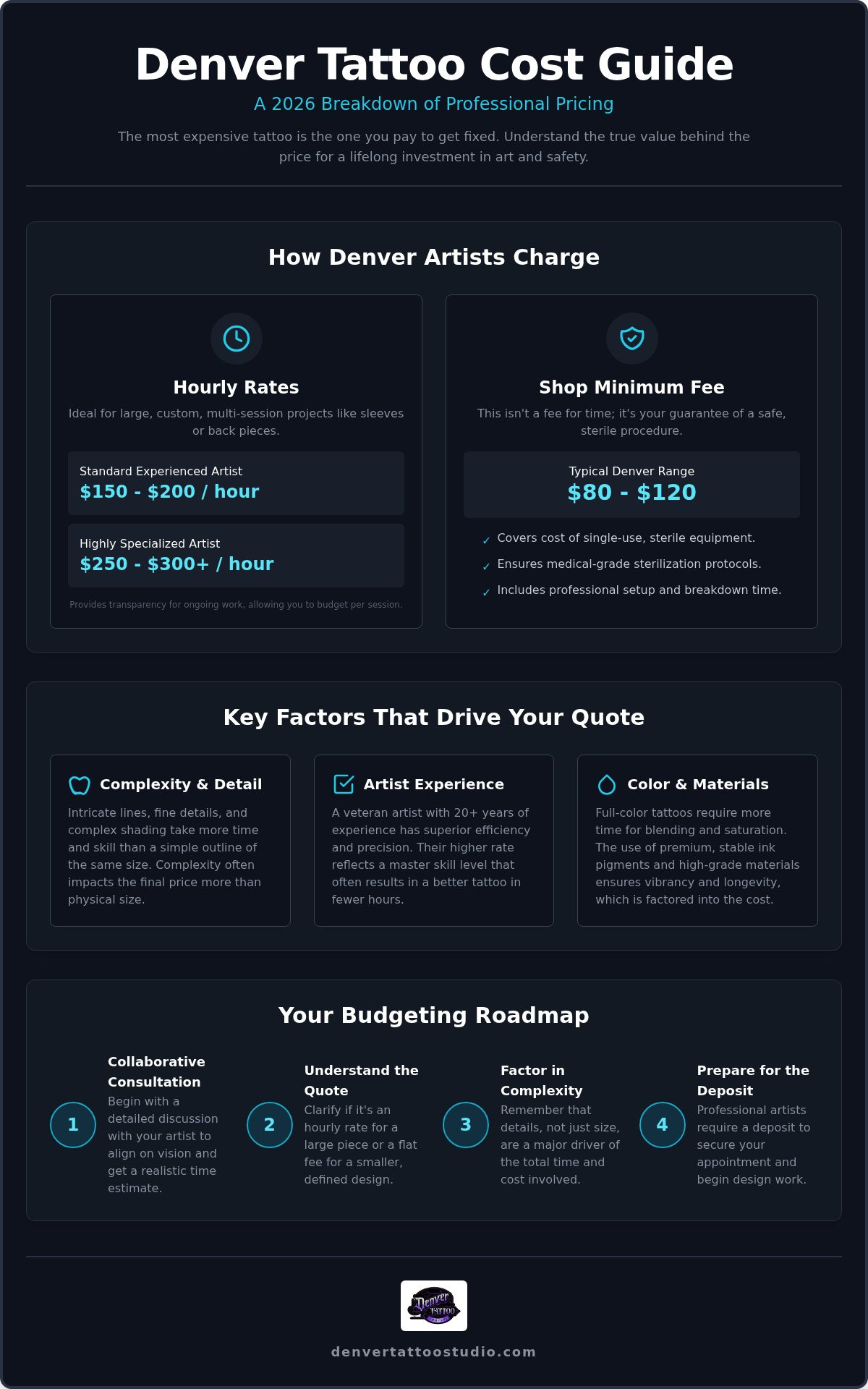
Understanding how artists bill for their time is a fundamental step in planning your investment. Most professional studios in the Denver metro area utilize a combination of hourly rates and flat fees, depending on the project's scope and complexity. For 2026, standard hourly rates for experienced artists typically fall between $150 and $200. Highly specialized creators, such as those focusing on hyper-realism or large-scale illustrative work, may range from $250 to $300 or more per hour. This structure ensures that both the artist's focused technical skill and the quality of the pigments used are fairly compensated. It also provides a clear framework for how much do tattoos cost in Denver when you're planning a custom piece.
Every reputable studio maintains a shop minimum, which in Colorado usually ranges from $80 to $120. This fee isn't merely a basic charge for a small design; it's a guarantee of a sterile, professional setup. It covers the overhead of medical-grade sterilization, high-end single-use needles, and the meticulous preparation required for even the smallest mark. Whether a design takes fifteen minutes or nearly an hour, the professional standards for hygiene and technical setup remain identical. Paying the shop minimum ensures that your artist is using the same high-quality equipment for a small symbol as they would for a major project.
When Hourly Rates Make Sense
Large-scale custom work is almost exclusively billed by the hour. This "pay-as-you-go" model offers total transparency for multi-session projects like full sleeves or intricate back pieces. It allows you to budget for each sitting individually rather than facing a massive upfront cost for the entire project. When looking at data regarding tattoo artist wages and employment, it's clear that these professional rates reflect the high level of technical discipline required for permanent body art. Estimating total hours for a complex design is a collaborative process. A veteran artist can often provide a realistic window of time based on their efficiency and your specific skin type, which helps prevent surprises at the end of a session.
Flat Fees and Flash Tattoos
Flat-rate pricing is the standard for "flash" art. These are pre-designed pieces that an artist has already drawn and is ready to apply. Flash offers predictable pricing for those who appreciate an artist's specific aesthetic without the added design time required for custom work. Small, symbolic tattoos also frequently fall into a flat fee category, though they often align with the shop minimum due to the fixed costs of a sterile setup. While walk-in tattoos are often priced with flat fees for simplicity, scheduled custom work is a different process. If you have a unique vision that requires tailored design time, booking professional tattoo consultations is the most reliable way to receive an accurate quote for your specific idea.
Calculating Complexity: Factors That Drive Your Quote
A common misconception in the tattoo industry is that physical size is the only metric for pricing. When you're researching how much do tattoos cost in Denver, you'll quickly find that a two inch micro-realism portrait can be more an investment than a six inch simple silhouette. Detail, not just square inches, is the true measure of the artist's time. A high-detail piece requires multiple needle configurations, intricate layering, and a level of focus that simple line work does not demand. This complexity is why a consultation is essential; it allows the artist to evaluate the technical requirements of your vision.
Color choice and custom design time also play significant roles in the final quote. Black and grey work relies on varying dilutions of ink to create soft gradients, while color tattoos often require multiple passes to "pack" the pigment for long-term vibrancy. Beyond the physical application, custom work involves "invisible labor." This is the time spent researching, sketching, and refining your design before the needle ever touches your skin. This creative phase ensures that the work is unique to you and technically sound for the specific area of your body. All of this professional preparation is performed in accordance with Colorado body art safety regulations, which dictate the high standards for hygiene that every reputable studio must maintain.
The Detail and Style Factor
Technical precision varies wildly between styles. Fine line work and realism require a master’s touch to ensure the ink is deposited at the correct depth without blurring over time. Cover-ups and re-works add another layer of difficulty. In these cases, the artist must work with existing pigments and potentially scarred skin, requiring a sophisticated understanding of color theory and skin anatomy to achieve a clean result. Proper shading and gradient work take time to build, ensuring the transition from light to dark is seamless and holds its integrity as it heals.
Placement and Skin Type
The human body is not a flat canvas. Areas like the ribs, neck, and joints are notoriously difficult to tattoo because the skin is thinner, more sensitive, or constantly in motion. These placements often require the artist to work more slowly and take frequent breaks to ensure both the client's comfort and the precision of the application. Skin elasticity and texture also vary by location; the forearm provides a relatively steady surface, whereas the abdomen or lower back may require more stretching and careful tension. This physical demand on the artist is a direct factor in how much do tattoos cost in Denver for specific body placements.
Budgeting for Your Denver Tattoo: A Practical Guide
Creating a realistic budget is the best way to ensure a stress-free experience from the first sketch to the final heal. While specific quotes vary based on the artist's tenure and the piece's intricacy, understanding the general structure of how much do tattoos cost in Denver allows you to plan effectively. Small, symbolic pieces typically align with a studio's shop minimum, while medium-sized designs often reflect several hours of focused labor. For large-scale projects, it's helpful to view the cost as a series of session payments rather than a single lump sum. This approach makes high-end custom work accessible while respecting the artist's dedicated time.
Beyond the tattoo itself, your budget should account for professional etiquette and long-term care. In Colorado, tipping between 15% and 20% is a standard way to show appreciation for an artist’s technical skill and the collaborative energy they bring to the project. Don't forget to set aside a small amount for high-quality aftercare products. Investing in pH-balanced soaps and specialized fragrance-free lotions is essential for protecting the integrity of the ink during the initial healing phase. These small steps ensure your investment remains vibrant for a lifetime and prevents the need for early touch-ups.
The Consultation and Deposit
A professional consultation at Denver Tattoo Company serves as the foundation for your budget. During this meeting, you'll discuss the nuances of your design, which helps the artist provide a more accurate estimate of the required time. It's standard practice to provide a non-refundable deposit to secure your appointment date. This payment isn't an extra fee; it's usually applied toward the final cost of your tattoo. It compensates the artist for the hours spent researching and drawing your custom design before you even arrive at the studio. If you have concerns about price fluctuations, this is the perfect time to ask about how complexity or color might influence the total.
Hidden Costs of 'Cheap' Tattoos
The allure of a bargain can be tempting, but "kitchen table" tattoos often lead to significant financial and health burdens. Unlicensed environments lack the medical-grade sterilization required to prevent serious infections, which can result in costly medical bills. From an aesthetic standpoint, poor-quality work often requires expensive laser removal or complex professional cover-ups that cost far more than the original piece. Investing in a master artisan like Jason Oz ensures that the work is done correctly the first time. The long-term value of safety, artistic integrity, and a piece you are proud to wear far outweighs the initial savings of a cut-rate service. To start your project with a clear plan, we recommend booking one of our tattoo consultations to discuss your vision.
Why Quality and Safety Define the Price at Denver Tattoo Company
When evaluating how much do tattoos cost in Denver, it's essential to look beneath the surface of the price tag. The cost of a professional tattoo is a direct reflection of the safety standards and technical expertise provided by the studio. At Denver Tattoo Company, our commitment to your health is absolute. We utilize only single-use, medical-grade sterilized equipment for every procedure. This rigorous approach to hygiene is a non-negotiable part of our process. It ensures that every client receives their art in a controlled, professional environment that exceeds standard requirements.
The materials we choose are just as important as the tools we use. We select premium inks and high-end equipment specifically because they ensure your tattoo heals vibrantly and maintains its integrity over time. Cheaper pigments often blur or fade prematurely, but our investment in quality materials protects the longevity of your work. Jason Oz brings over 20 years of industry experience to every project, providing a level of artistic integrity that only decades of practice can produce. You're investing in a master artisan who understands the nuances of skin anatomy, pigment behavior, and technical precision.
The Denver Tattoo Company Difference
Our studio philosophy centers on custom storytelling rather than high-volume turnover. We've created a clean, welcoming space in Englewood that serves as a creative sanctuary for both newcomers and veteran collectors. We believe the process should be a collaborative partnership. This means we provide transparent pricing from the start. There are no hidden fees or surprise costs at the end of your session. Instead, we offer honest artistry and a steady hand, ensuring you feel confident in the value of the work being performed.
Book Your Consultation Today
The first step toward your new piece is a professional meeting to discuss your vision. To get the most accurate quote for how much do tattoos cost in Denver regarding your specific idea, come prepared with your reference images and thoughts on placement. During your consultation, we'll break down the technical requirements and time estimates for your custom tattoo designs. This ensures your budget is clear and your expectations are met before the first needle is even opened. We are here to act as your creative partner and guide you through every step of the process. Ready to start? Schedule your custom tattoo consultation in Denver today.
Invest in Art That Lasts a Lifetime
Choosing the right studio is about finding a balance between artistic vision and technical safety. We've explored how factors like placement, detail, and artist tenure influence how much do tattoos cost in Denver, but the most important factor is the value you place on your own skin. A tattoo is one of the few things you'll carry forever. It's an investment in your personal story and the artisan who brings it to life. At Denver Tattoo Company, we combine over 20 years of professional experience with strict single-use sterilization protocols to ensure your experience is as safe as it is creative.
Whether you're dreaming of intricate fine-line work or a bold realism piece, we're here to provide a transparent, professional environment from the first sketch to the final heal. Your vision deserves a steady hand and a collaborative partner who respects the permanence of the craft. Book your custom tattoo consultation with Jason Oz today and let's discuss how we can turn your ideas into exceptional permanent art. We look forward to welcoming you into our Englewood studio and helping you start your next project with confidence.
Frequently Asked Questions
What is the average hourly rate for a tattoo artist in Denver in 2026?
Standard hourly rates for professional artists in the Denver metro area are determined by their tenure and technical specialization. You'll find that veteran creators focusing on realism or fine-line work command rates that reflect their efficiency and artistic mastery. This structure ensures that the quality of your permanent work matches the level of skill required to execute it, which is a key factor when considering how much do tattoos cost in Denver.
Do tattoo shops in Englewood charge a shop minimum?
Professional studios in Englewood utilize a shop minimum to ensure every procedure meets medical-grade safety standards. This fee is not an arbitrary charge but a baseline to cover the essential costs of a sterile setup, including single-use needles and premium pigments. It guarantees that the standards for hygiene and technical preparation remain consistent, regardless of the tattoo's size or simplicity.
How much should I tip my tattoo artist in Colorado?
Tipping your artist is a standard practice in Colorado, similar to other service-based professional industries. A gratuity of 15% to 20% is typically expected for high-quality artistry and a collaborative experience. It's a direct way to acknowledge the technical discipline and creative effort your artist invested in your permanent work, especially for long or complex sessions that require significant focus.
Is a deposit required to book a tattoo at Denver Tattoo Company?
Yes, a non-refundable deposit is required to secure your appointment time at our studio. This payment ensures your date is reserved and compensates the artist for the specialized labor involved in creating your custom design before the session begins. The deposit amount is typically applied toward the final cost of your tattoo on the day of your appointment, serving as a commitment to the collaborative process.
Why do custom tattoos cost more than flash designs?
Custom tattoos require a dedicated creative phase that flash designs do not. When an artist creates a custom piece, they spend hours researching, sketching, and refining the art to fit your specific body placement and personal story. This "invisible labor" is a significant part of how much do tattoos cost in Denver, as it ensures you receive a one-of-a-kind piece tailored solely to your vision.
Can I get a price quote over the phone or via email?
Providing an accurate quote over the phone or via email is challenging because of the many variables involved in a professional tattoo. Factors like skin elasticity, the level of intricate shading, and the exact placement on your body are best assessed in person. We recommend a consultation to ensure we can provide a realistic budget based on your specific design ideas and technical needs.
Does the price of a tattoo include aftercare products?
The price of the tattoo generally covers the technical application and the sterile setup rather than aftercare products. While some studios might provide a small sample, you should budget for professional-grade soaps and fragrance-free lotions. Investing in these items is a vital part of the process to ensure your new ink heals correctly and maintains its vibrancy for years to come.
What happens to my deposit if I need to reschedule my session?
Deposits are generally transferable if you provide sufficient notice for rescheduling, usually at least 48 hours. This allows the artist time to fill the empty session and protects their livelihood. If a session is canceled or rescheduled without proper notice, the deposit is typically forfeited to cover the lost time and the work already performed on your custom design before your arrival.


