
Why does a three-inch mountain silhouette cost twice as much at one studio compared to another just down the street? It's common to feel a sense of confusion or even anxiety when you start researching tattoo pricing Denver. You want to ensure you're investing in permanent, high-quality artistry without the fear of hidden costs or being overcharged. We understand that a tattoo is more than just ink; it's a collaborative creative process that requires technical precision and meticulous safety standards.
This guide will provide a clear look at the factors that determine market rates in the metro area so you can plan your budget with ease. We'll examine the nuances between hourly and flat-rate pricing, the value of artist experience, and why a detailed consultation is the most reliable way to secure an accurate quote for your next custom design. By exploring these technical standards and studio philosophies, you will gain the knowledge needed to navigate the booking process with confidence and clarity.
Key Takeaways
- Understand why professional studios implement a shop minimum to maintain a safe, sterile environment for every client.
- Learn the differences between hourly billing and flat fees to better anticipate how your artist will calculate the final cost of your project.
- Discover how to navigate tattoo pricing Denver by distinguishing between the collaborative custom design process and the straightforward nature of walk-in services.
- Gain a realistic framework for budgeting large-scale work, such as sleeves or multi-session pieces, through intentional financial planning.
- Recognize how premium materials and seasoned artistry ensure the long-term integrity and safety of your permanent investment.
Denver Tattoo Pricing: What to Expect in 2026
Understanding tattoo pricing Denver requires looking past the final number to the professional discipline behind the needle. As the industry evolves, the cost of permanent artistry reflects more than just ink and time. It represents a commitment to technical safety, artistic longevity, and the high standards of a regulated environment. While the history and cultural significance of tattoos spans centuries, the modern financial structure of a studio is built on the rigorous demands of contemporary hygiene and specialized skill.
The Concept of the Shop Minimum
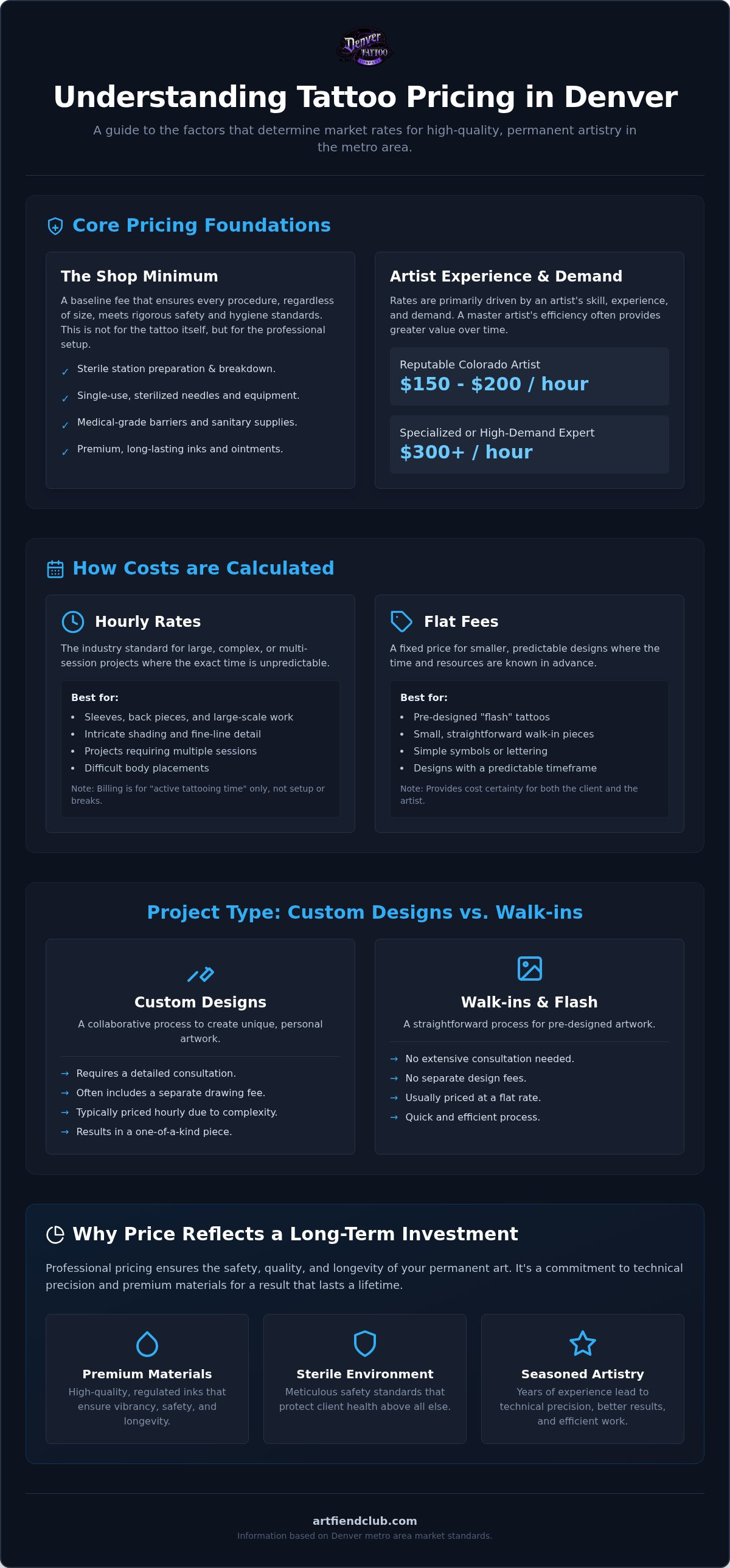
Every session begins long before the machine touches the skin. In a professional environment, the "shop minimum" serves as a baseline to cover the fixed costs of a sterile procedure. This includes the preparation of the station, the use of single-use sterilized needles, medical-grade barriers, and premium inks that ensure the work remains vibrant for years. Even a design that takes fifteen minutes to execute requires the same comprehensive setup as a three-hour session. This baseline ensures that safety is never compromised for the sake of a smaller project. Maintaining these standards is a core priority for a tattoo only studio Denver, where every resource is dedicated specifically to the mastery of the craft rather than split between various cosmetic services.
Local Market Variables in Colorado
The Denver metro area presents a diverse landscape of pricing that often fluctuates by neighborhood. Studios in high-traffic downtown districts may have different overhead considerations than a focused, artist-led studio in Englewood or Lakewood. Beyond geography, the primary driver of cost is artist demand and experience. A master artisan with over two decades of industry experience typically operates at a higher hourly rate than a junior artist, reflecting their technical efficiency and ability to handle complex skin types or placements. In the current Colorado market, reputable artists generally begin their rates around $150 to $200 per hour, though specialized experts or those in high demand may exceed $300.
It's also vital to distinguish between a price estimate and a price quote. An estimate is a professional projection of the time a custom piece might take, allowing for variables like skin texture or client breaks. A quote is typically a firm, fixed price often reserved for pre-drawn "flash" designs or smaller, predictable works. Understanding this distinction helps you enter a consultation with realistic expectations, ensuring the focus remains on the creative fulfillment of the piece rather than unexpected financial shifts.
Hourly Rates vs. Flat Fees: How Denver Artists Calculate Costs
Determining the final cost of your piece involves understanding how a studio values time and expertise. Most professional tattoo pricing Denver is structured around either an hourly rate or a flat fee. This choice isn't arbitrary; it's a reflection of the project's complexity and the artist's specific workflow. For instance, Jason Oz brings over 20 years of industry experience to every session. This level of mastery translates to technical efficiency. While a senior artist's hourly rate might be higher than a newcomer's, their speed and precision often mean the total session time is shorter, providing better value for a superior result.
Professional rates also account for the use of premium materials that meet FDA safety regulations for tattoo inks, ensuring your health is prioritized alongside the aesthetic outcome. Beyond the time spent tattooing, many custom projects involve a drawing fee. This covers the labor required to conceptualize and refine your artwork before the appointment begins. It's a standard practice that respects the artist's time during the design phase, ensuring that when you arrive, the focus remains entirely on the precise application of your art.
When Hourly Pricing Makes Sense
Hourly billing is the industry standard for large-scale, intricate work. When a project involves complex shading, fine lines, or difficult placements, it's nearly impossible to predict the exact minute the piece will be finished. Artists typically bill for "active tattooing time," which means you aren't paying for the artist's setup, cleanup, or lunch breaks. This model is fair for both parties, as it accounts for the unique way every individual's skin takes ink. If you're planning a project that requires multiple sessions, you can schedule a professional consultation to get a realistic estimate of the total hours involved.
The Logic Behind Flat-Rate Tattoos
Flat rates are common for pre-designed "flash" or smaller, predictable walk-in pieces. This model provides immediate price certainty, which is ideal for clients who prefer to know the exact cost upfront. Because the artist has already drawn the design and knows exactly how long it takes to execute, they can offer a fixed price. However, as designs become more personalized, the billing usually shifts. Most custom tattoo designs Denver lean toward hourly billing because the collaborative nature of the work introduces variables that a flat rate can't always cover.
Custom Designs vs. Walk-ins: Understanding the Price Difference
The choice between a custom piece and a spontaneous walk-in significantly impacts tattoo pricing Denver. As we see steady tattoo industry growth, the market has become more segmented to accommodate different client needs. Custom work is a collaborative journey that transforms a personal concept into a permanent masterpiece, whereas walk-ins focus on efficiency and immediate execution. Both services have their place in a professional studio, but they operate on distinct financial and creative logic.
The Value of the Consultation
A custom design is a tailored piece of art meticulously crafted to fit your specific anatomy and personal narrative. This process begins with a dedicated meeting where you and your artist align on the vision. Knowing what to ask during a tattoo consultation helps you articulate your goals while allowing the artist to evaluate the technical requirements of the piece. This interaction is where the most accurate pricing is established. To secure a spot on the calendar, most reputable shops require a non-refundable deposit. This deposit is not an additional charge; it's a commitment that is typically applied toward the final cost of your session, protecting the artist's time and your scheduled appointment.
Walk-in Pricing Dynamics
Walk-ins are generally priced for speed and simplicity. These sessions often involve "flash" designs or small, straightforward requests that don't require the extensive preparation time of custom work. Because the artist can execute these pieces with high technical efficiency, the entry cost is often lower. This makes walk-ins an excellent way to experience a studio's hygiene standards and artistic quality without a long-term planning phase. However, walk-in pricing has inherent limitations. You won't be able to secure complex realism, large-scale geometry, or intricate portraits on a first-come, first-served basis. Those projects require the planning and expertise found only in the custom design process.
Balancing your artistic desires with a specific budget often involves a conversation about scale and detail. A smaller tattoo with extreme detail can sometimes cost as much as a larger, simpler piece because the technical difficulty and time required are higher. If you have a specific financial target, transparency with your artist is key. A seasoned professional can suggest ways to adjust the design or placement to meet your budget without compromising the longevity or integrity of the artwork. This collaborative approach ensures you receive a piece that you're proud of at a price that feels fair and sustainable.
Budgeting for Large-Scale Projects: Sleeves and Multi-Session Art
Entering the world of large-scale work like back pieces or full sleeves requires a shift in perspective. You're no longer looking at a single transaction but a long-term artistic partnership. This is where tattoo pricing Denver becomes a matter of strategic financial planning rather than a one-time expense. Understanding the timeline and the various billing structures for multi-session art allows you to invest in high-quality craftsmanship without financial strain.
Planning the Financial Timeline
Most clients find it manageable to break down the total cost of a sleeve over several months. Sessions are typically spaced four to six weeks apart. This rhythm serves a dual purpose: it gives your skin the necessary time to recover and your bank account time to replenish between appointments. Consistency is vital for these projects. Working with a single master artisan like Jason Oz ensures that the artistic vision remains cohesive and the pricing structure stays predictable throughout the project's duration. To plan effectively, consider these steps:
- Determine the total estimated hours during your initial consultation to understand the full scope.
- Decide between Full Day or Half Day sessions based on your physical endurance and monthly budget.
- Set aside a fixed amount each month specifically for your upcoming appointments to avoid surprises.
Maximizing Your Session Value
Arriving prepared is the most effective way to ensure your investment goes toward permanent ink rather than logistical delays. Session efficiency is the ratio of ink-to-skin time versus preparation and break time. If you arrive hydrated, well-fed, and with moisturized skin, you minimize the need for extra breaks or skin preparation. This preparation allows the artist to focus entirely on the technical application of the design.
Placement also plays a significant role in the time required for a session. Intricate areas like the ribs, neck, or inner bicep naturally take longer to tattoo than flat surfaces like the forearm or outer thigh. These areas require more careful skin tensioning and slower movements to ensure the ink is deposited correctly. Choosing between a Full Day and Half Day rate depends on your personal goals. A full day allows for significant progress and deeper artistic focus, which can be more efficient for complex realism. Half days are excellent for those who prefer shorter bursts of work or have tighter monthly budget constraints. To begin planning your large-scale investment, you can book a consultation to discuss your sleeve project and receive a tailored timeline.
Why Professional Standards and Experience Define Your Investment
When evaluating tattoo pricing Denver, it's essential to look beyond the surface of the design and consider the operational discipline required to create permanent art safely. A tattoo is a medical procedure as much as it is an artistic one. The price you pay reflects a studio's commitment to a clean, focused, and highly dedicated environment where your health and the longevity of your ink are the primary priorities. Choosing a studio based solely on the lowest quote often ignores the technical infrastructure necessary to ensure a successful outcome.
The Cost of Safety and Hygiene
A clean, focused environment is built on non-negotiable technical standards. Every session involves a significant inventory of medical-grade supplies that are used once and then responsibly discarded. This includes single-use sterilized needles, specialized barrier films, and premium inks that meet rigorous safety profiles. These aren't optional extras; they're the foundation of a safe tattoo studio Denver. When a studio cuts costs, these are often the first areas to suffer, leading to higher long-term risks such as poor healing or the need for expensive medical touch-ups.
The true cost of a "cheap" tattoo often reveals itself months or years later. Substandard equipment or a lack of proper sterilization protocols can result in infections or allergic reactions that far outweigh the initial savings. A professional studio invests heavily in high-end sterilization equipment and continuous training to maintain a clinical level of hygiene. You aren't just paying for the artist's time; you're paying for the peace of mind that comes with knowing every precaution has been taken to protect your skin.
Longevity and Artistic Integrity
Artistic integrity is a product of long-term discipline. Jason Oz's 20+ years of industry experience provides a level of technical mastery that ensures your tattoo looks as intended for decades. A seasoned expert understands the nuances of skin anatomy, knowing exactly how deep to place the ink to prevent "blurring" or premature fading. This precision is what separates a piece that remains sharp and vibrant from one that loses its definition within a few years. Experience allows an artist to anticipate how different placements on the body will age, guiding you toward a design that stands the test of time.
Fixing a poor-quality tattoo is almost always more expensive and complicated than doing it right the first time. Cover-ups often require more sessions, darker pigments, and a larger footprint to mask the original mistake. By investing in master artistry from the start, you avoid the physical and financial burden of corrective work. It's a commitment to your body that respects the permanence of the medium.
Finally, remember to factor in aftercare and gratuity when finalizing your total budget. High-quality aftercare products are essential for the healing process and preserving the ink's integrity. Gratuity, while always at your discretion, is a standard industry practice that acknowledges the collaborative effort and technical skill involved in your session. By accounting for these elements, you ensure a smooth, professional experience that honors both the artist's craft and your personal investment.
Planning Your Permanent Investment
Investing in a tattoo is a commitment to a lifelong piece of art. Understanding the variables behind tattoo pricing Denver allows you to focus on what matters most: the technical safety and artistic integrity of the work. We've explored how hourly rates reflect professional discipline, why shop minimums protect your health through sterile standards, and how custom designs offer a collaborative value that walk-ins cannot match. With the right preparation and a realistic budget, you can ensure your next piece is a source of pride for decades to come.
Ready to transform your vision into a reality? Jason Oz brings 20+ years of professional experience and a mastery of custom realism to every session. Our studio prioritizes your safety by using only single-use sterilized equipment within a focused, dedicated environment. Schedule a Consultation with Jason Oz to Get an Accurate Quote and begin your journey toward high-quality, permanent artistry. We look forward to collaborating with you on a piece that truly tells your story.
Frequently Asked Questions
How much is a small tattoo in Denver on average?
The cost of a small tattoo in the Denver metro area is primarily determined by the studio's shop minimum. This baseline fee ensures that even the smallest designs are applied using the same medical-grade sterilization and single-use equipment as a full-day session. When researching tattoo pricing Denver, you'll find that professional studios set a minimum that reflects their overhead and commitment to technical safety.
What is the typical hourly rate for a tattoo artist in Englewood, CO?
Hourly rates in Englewood and the broader Denver area typically reflect the artist's experience level. A seasoned professional like Jason Oz, with over 20 years of industry experience, operates at a rate that accounts for both technical speed and artistic mastery. Most reputable local studios operate within a standard market range that balances the cost of premium materials with the time required for precise application.
Do Denver tattoo shops charge for the time they spend drawing my design?
Many professional studios in the Denver area include a drawing fee or design fee for custom work. This covers the labor required to conceptualize and refine your unique artwork before your appointment begins. It's a standard practice that respects the artist's creative time during the design phase. This ensures that when your session starts, every detail is already perfected and ready for application.
Why do I need to pay a deposit for a tattoo consultation?
A deposit is typically required to secure your appointment on the artist's calendar and to protect the time set aside for your collaborative design process. In most Denver shops, this non-refundable deposit is eventually applied toward the final cost of your tattoo. It acts as a commitment from both the client and the artist, ensuring that the resources dedicated to your custom project are valued and respected.
How much should I tip my tattoo artist in Colorado?
Tipping is a standard industry practice in Colorado that shows appreciation for the artist's technical skill and the personal attention provided during your session. While the amount is always at your discretion, many clients follow a standard service industry percentage similar to what they might offer in other professional settings. It is a thoughtful way to acknowledge the collaborative effort and the artistic integrity of your permanent piece.
What factors make a tattoo more expensive besides just the size?
Several factors influence tattoo pricing Denver beyond the physical dimensions of the piece. The level of detail, the complexity of the style, and the specific placement on the body all play significant roles. For example, intricate realism or tattoos on difficult areas like the ribs require more time and technical precision. The artist's experience and the quality of materials used also contribute to the final investment you make in your skin.
Is it cheaper to get a black and grey tattoo than a color one?
Not necessarily. While color tattoos may require more time for blending and pigment saturation, a complex black and grey realism piece can be just as labor-intensive. The cost is usually driven by the time required to achieve the desired level of depth and detail rather than the specific palette used. A master artist will focus on the technical application and the long-term integrity of the ink regardless of the color scheme.
How much does a full sleeve tattoo cost in the Denver area?
The total cost for a full sleeve in the Denver metro area depends on the total number of hours required to complete the project. These large-scale works are typically billed over multiple sessions, allowing you to manage the budget over several months. Factors such as the intricacy of the custom design and how your skin takes the ink will determine the final timeline. A consultation is the best way to get a realistic estimate for your sleeve.


