
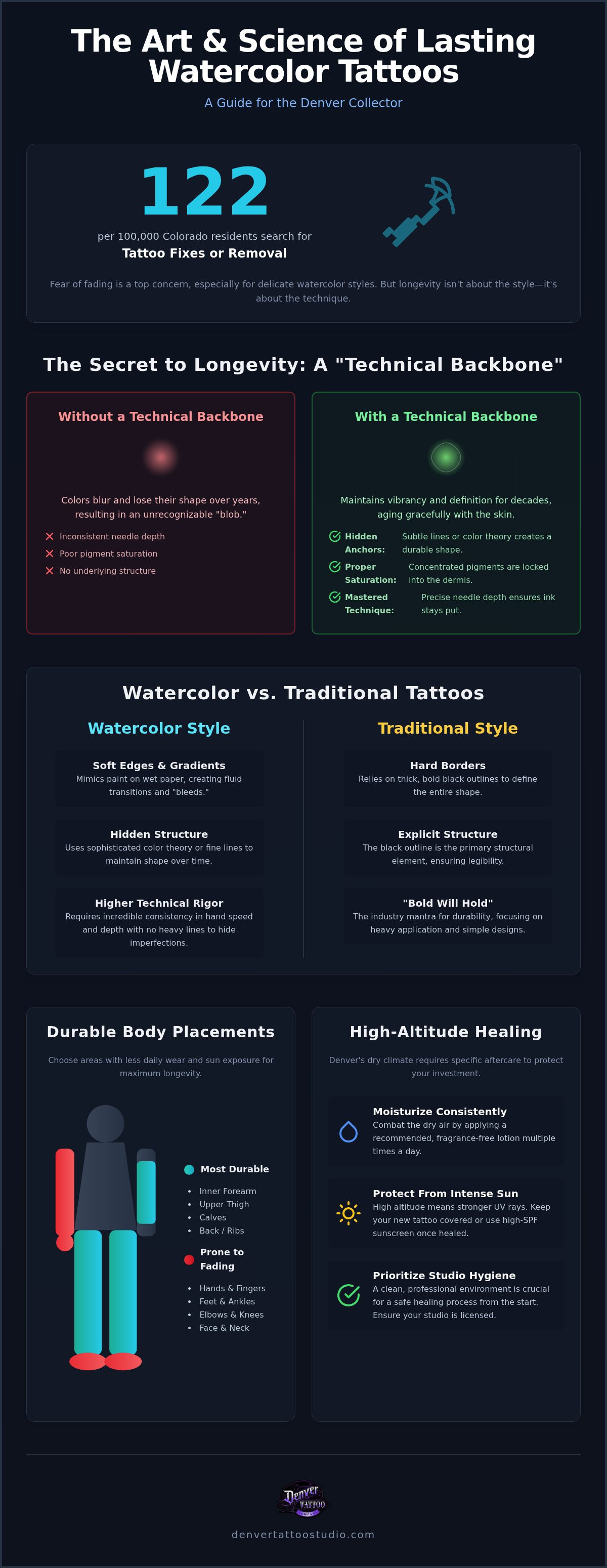
Colorado currently holds the highest rate of "tattoo regret" searches in the United States, with roughly 122 residents per 100,000 looking for ways to fix or remove past decisions. For those drawn to the delicate beauty of a painterly aesthetic, this statistic often fuels the fear that a soft design will eventually fade into an unrecognizable blur. You want a piece that captures the fluid movement of paint, but you also need it to maintain its shape for decades to come. Finding a skilled watercolor tattoo artist Denver residents can rely on requires looking for someone who prioritizes technical longevity as much as visual impact.
We believe that a tattoo should be a collaborative masterpiece that respects both your vision and the biology of your skin. This guide will teach you how to choose an artist who uses a "technical backbone" to ensure your colors stay vibrant and defined. We'll cover the essential questions to ask during a consultation, what to look for in a professional studio environment, and how to navigate the specific challenges of healing a tattoo in our dry, high-altitude climate.
Key Takeaways
- Learn how a technical backbone and hidden black anchors prevent soft watercolor gradients from losing their shape as they age.
- Identify the most durable body placements to ensure your watercolor tattoo artist Denver can create a piece that withstands daily wear and sun exposure.
- Prepare for a successful consultation by understanding which types of reference images, like fluid paintings or digital art, translate best to skin.
- Recognize the importance of studio hygiene and professional licensing to ensure your creative experience is as safe as it is fulfilling.
- Master the specific healing protocols required to maintain ink vibrancy in the unique, dry climate of the Denver area.
What Defines a Watercolor Tattoo Artist in Denver?
Watercolor tattooing is a distinct form of body modification that challenges the traditional boundaries of ink on skin. Unlike styles that rely on heavy black outlines to define a shape, watercolor mimics the behavior of pigment on wet paper. It utilizes soft edges, gradients, and intentional splatters to create a sense of movement. A skilled watercolor tattoo artist Denver collectors seek out must understand how to translate these delicate effects into a permanent medium. This requires a deep knowledge of skin anatomy, as the artist isn't just drawing; they're layering translucent washes of color to build depth. It's a disciplined process that demands more than just an eye for color. It requires a mastery of needle depth to ensure the ink stays where it's placed without the "safety net" of a thick border.
The "Denver Style" has emerged as a preference for organic, nature-inspired themes that reflect our local landscape. Whether it's the shifting hues of a Rocky Mountain sunset or the delicate petals of a columbine, local collectors are moving away from rigid structures in favor of fluid, expressive art. This shift demands a specific type of professional. While many people can paint on canvas, a true watercolor tattoo specialist understands that skin is a living, changing organ. They must balance the desire for soft aesthetics with the technical necessity of pigment saturation to ensure the work remains legible over time. This is why technical precision is actually higher in watercolor than in many traditional styles; there is no room for error when you're blending colors directly into the dermis.
The Aesthetic of Fluidity and Motion
Achieving a painterly look on skin involves more than just picking bright colors. Experts use negative space, the untouched skin, to act as the "white paint" that creates highlights and the illusion of light. By layering different pigment washes, the artist creates a sense of three-dimensional depth that mimics the transparency of actual watercolors. Choosing a palette is also a strategic process. In Denver, where the sun is intense, selecting colors with high lightfastness is essential for maintaining the tattoo's integrity. A collaborative consultation helps determine which hues will complement your skin tone while surviving the elements.
Watercolor vs. Traditional Tattoos
The old industry mantra "bold will hold" suggests that only thick black lines can stand the test of time. While traditional styles are certainly durable, modern advancements in equipment and ink have changed the possibilities. Watercolor tattoos don't necessarily lack structure; they simply use "hidden" anchors or sophisticated color theory to maintain their shape. Consider these differences:
- Soft Edges: Watercolor relies on smooth transitions and "bleeds" rather than hard borders.
- Vibrant Suspension: Modern, premium inks allow for a higher concentration of pigment without the need for a black "fence" to keep them contained.
- Technical Rigor: Because there are no lines to hide behind, the artist's needle depth and hand speed must be incredibly consistent to avoid blotchiness.
At Denver Tattoo Company, we utilize only premium, sterile inks and single-use equipment to ensure every custom design is as safe as it is beautiful. This commitment to hygiene and technical excellence is why our studio in Englewood remains a focused environment for those seeking high-end artistry from a watercolor tattoo artist Denver trusts.
The Longevity Debate: Will Your Watercolor Tattoo Fade?
The most common concern for anyone searching for a watercolor tattoo artist Denver offers is whether the art will survive the test of time. There is a persistent misconception that these painterly designs inevitably blur into an unrecognizable "blob" within a few years. While it's true that some watercolor tattoos age poorly, this is almost always a result of inadequate technique rather than an inherent flaw in the style. Longevity depends on how the pigment is anchored within the skin. Veteran artists with over 20 years of experience, such as Jason Oz, have spent decades observing how different ink applications settle and shift over time. This historical perspective is vital because it allows an artist to predict how a soft gradient will look ten or twenty years down the road.
Technical success in this style relies heavily on tattoo ink safety and the quality of the pigments used. Higher-grade inks with concentrated pigments are less likely to break down quickly. At Denver Tattoo Company, we focus on saturation and precise needle depth to ensure the work stays vibrant. If the ink is placed too shallow, it sheds with the skin; if it's too deep, it causes blowouts. Finding that precise middle ground is where the master artisan's skill truly shines, ensuring the colors remain crisp without the need for a traditional black border.
The "Skeleton" of a Watercolor Piece
Even the softest watercolor piece needs a structural foundation. Many artists use a "bloodline" technique, which involves tattooing with water or a very light grey wash to map out the design's architecture without leaving a visible black line. These "black anchors" or high-contrast color choices provide a visual framework that keeps the design legible as the skin ages. Without this structure, you risk excessive ink migration. Ink migration is the natural process where pigment particles slowly disperse within the dermis. By using high-contrast borders between colors, an artist can mitigate the visual impact of this movement and maintain the tattoo's intended shape.
The Impact of Sun Exposure in Colorado
Living in Colorado presents a unique challenge for tattoo preservation. Denver's 300 days of annual sunshine and high altitude mean your skin is subjected to intense UV radiation, which is the primary enemy of tattoo pigment. UV rays break down ink particles, causing them to fade much faster than they would in more overcast climates. For watercolor collectors, UV protection is non-negotiable. We often recommend placements like the inner forearm, ribs, or shoulder blades, which are easier to shield from direct sunlight. Protecting your investment starts with choosing a location that isn't constantly exposed to the elements.
If you are ready to discuss a design that balances beauty with durability, reaching out for tattoo consultations is the first step toward a piece you will love for a lifetime.
Choosing the Right Placement and Palette in Denver
Selecting the location for your new piece is just as critical as the design itself. Because watercolor relies on subtle gradients and soft edges, it requires a "canvas" that provides a relatively flat, stable surface. Tattoos are an ancient and universal tradition used to tell personal stories, and the placement you choose dictates how that story ages. For the best results, a watercolor tattoo artist Denver collectors trust will typically recommend the outer forearm, the calf, or the shoulder blade. These areas offer enough space for the artist to execute long, fluid brushstrokes without the distortion caused by heavy joint movement or skin folds.
You should generally avoid high-friction areas if you want your watercolor art to stay crisp. Fingers, palms, and inner thighs experience constant rubbing and rapid skin cell turnover. This friction causes the delicate pigment washes to blur much faster than they would on a limb. During your consultation, we'll look at your skin's natural undertones to select a palette that stays vibrant. Cool undertones often pair beautifully with the deep blues and purples of a Rocky Mountain twilight, while warmer undertones can make the fiery oranges and magentas of a Colorado sunset truly pop. This "Denver Palette" isn't just about local pride; it's about choosing high-contrast colors that remain distinct as they settle into your specific skin tone.
Placement for Long-Term Artistry
Flatter skin surfaces allow for the most intricate detail, mimicking the look of a painting on a gallery wall. While muscle movement can add a sense of life to a fluid design, excessive stretching can distort the delicate "splatters" that define the style. If you're considering future additions or a full sleeve, it's vital to plan your watercolor placement with expansion in mind. We often design pieces with "open" edges that allow for a seamless transition into future custom work, ensuring your collection feels like a single, cohesive narrative rather than a series of disconnected images.
Dealing with Denver's Dry Climate
The environmental conditions in Englewood and the surrounding Highlands Ranch area present a specific challenge for new ink. Our notoriously low humidity can strip moisture from a healing tattoo, leading to heavy scabbing that might pull pigment out of the skin. To preserve the soft washes of a watercolor design, you must prioritize both internal and external hydration. Skin elasticity is the foundation of a successful heal. We recommend a strict hydration schedule: drink at least 80 ounces of water daily and apply a thin layer of professional-grade aftercare ointment three to four times a day for the first two weeks. This consistent routine prevents the skin from becoming brittle, ensuring your vibrant colors remain trapped exactly where the artist intended.
The Collaborative Design Process: From Concept to Skin
Creating a custom watercolor piece is a journey that begins long before the needle touches your skin. Unlike traditional styles where you might pick a pre-made design from a portfolio, watercolor is deeply personal and fluid. It requires a detailed conversation to ensure the final result matches your emotional intent while adhering to the physical constraints of the medium. Finding a watercolor tattoo artist Denver residents can truly partner with means looking for someone who values the dialogue as much as the drawing. This collaborative approach ensures that the "painterly" elements you love are structured in a way that works with your body's unique canvas.
You might arrive with a photo of a specific mountain range, a digital painting, or even a vague description of a memory. A seasoned artist acts as a translator during this phase. They take these abstract inspirations and refine them into a format that will hold its integrity in the dermis. This often involves adjusting color values to create necessary contrast or ensuring the composition flows with your muscle structure. The goal is to capture the essence of your reference while making the technical choices required for a permanent piece of art. This precision is what separates a temporary trend from a lifelong masterpiece.
Preparing for Your Consultation
We recommend a "mood board" approach for your initial concept. Gather images that showcase the specific textures, color blends, and "splatter" effects you find appealing. This visual vocabulary helps bridge the gap between your vision and the artist's technique. It's essential to remain open to technical adjustments during this talk. For instance, an artist may suggest a darker core for a floral design to prevent it from looking flat as it heals. If you're ready to share your ideas, you can easily schedule your Tattoo Consultation Denver to begin the planning phase.
The Day of the Appointment
Your preparation on the day of the session directly impacts the final quality of the ink. Hydrated skin accepts pigment more readily, so we suggest increasing your water intake significantly in the 48 hours leading up to your visit. Avoid any sun exposure or tanning on the placement area, as we cannot tattoo over sun-damaged or peeling skin. Wear loose, comfortable clothing that provides easy access to the tattoo site while allowing you to remain relaxed during a multi-hour session. Our Englewood studio provides a clean, focused environment where your safety and creative fulfillment are our primary concerns. We utilize single-use sterilized equipment and premium pigments to ensure every custom design is executed with meticulous attention to detail.
If you're looking for a professional environment to bring your vision to life, we invite you to book your custom tattoo session with our experienced team.
Why Denver Tattoo Company is the Destination for Custom Art
Choosing a studio for a watercolor project is a decision that impacts the permanence and beauty of your body art for decades. At Denver Tattoo Company, we've built a reputation as a clean, focused environment where the craft of tattooing is treated with the seriousness it deserves. Led by Jason Oz, who brings over 20 years of industry experience to every project, our studio serves as a creative hub for collectors across Denver, Englewood, Lakewood, and Littleton. We don't view a tattoo as a mere transaction. Instead, we embrace a "Collaborative Storytelling" approach, ensuring that your vision is translated into a custom design that respects both your personal narrative and the technical requirements of the watercolor style.
Our commitment to artistic integrity means we prioritize the individual's experience above all else. While some larger shops may feel like high-volume factories, we maintain a master artisan personality that emphasizes quality over speed. This dedication is especially important for watercolor designs, which require a nuanced understanding of how soft pigments interact with different skin tones. When you're searching for a watercolor tattoo artist Denver residents can rely on for both aesthetic brilliance and technical longevity, you're looking for a team that balances professional authority with approachable warmth.
Mastery and Technical Safety
Safety is the foundation of our artistic process. We utilize only single-use sterilized equipment and premium, high-lightfast inks for every client, ensuring that your health is never compromised for the sake of art. Our veteran artists understand the delicate nature of watercolor pigments and how to apply them at the precise depth required to prevent premature fading. This "reassuring and serious" approach to craftsmanship has made us a trusted destination for both first-time collectors and experienced enthusiasts. We take the time to explain every step of the process, from the initial needle choice to the final application of color washes, providing a transparent and professional experience from start to finish.
Ready for Your New Piece?
Whether you're interested in a small, spontaneous design or a large-scale custom masterpiece, we're here to guide you. We welcome walk-in tattoos for smaller, less complex pieces that don't require extensive preparation. However, for the intricate gradients and layered effects of a watercolor project, we strongly recommend starting with a professional consultation. This allows us to discuss placement, color theory, and the structural "anchors" needed to keep your art looking sharp for years to come. You can find our studio conveniently located in Englewood, just south of the Denver metro area, providing a quiet and focused space away from the city's noise.
Your journey toward a vibrant, painterly tattoo begins with a conversation. We invite you to reach out and Schedule your watercolor consultation today to see how our expertise can bring your vision to life.
Bringing Your Vision to Life Through Technical Mastery
Choosing a watercolor design is an investment in personal storytelling that requires a delicate balance of artistic flair and technical discipline. As we've explored, the longevity of your piece depends on the use of hidden structural anchors and the application of premium pigments that can withstand the intense Colorado sun. By prioritizing professional consultations and selecting a studio that emphasizes safety, you ensure your art remains as vibrant as the day it was created. Finding a watercolor tattoo artist Denver collectors can trust means looking for a partner who values the permanence of the work as much as its immediate aesthetic impact.
At Denver Tattoo Company, we provide a focused environment where 20+ years of industry experience meets a dedicated focus on custom artistry. We utilize 100% single-use sterilized equipment to maintain the highest standards of hygiene for every client. Whether you're envisioning a soft, nature-inspired gradient or a bold, abstract splash of color, our team is ready to guide you through a safe and collaborative creative process. We look forward to helping you create a piece that reflects your unique style and stands the test of time.
Book Your Custom Watercolor Consultation at Denver Tattoo Company today and start your journey toward a permanent masterpiece.
Frequently Asked Questions
Do watercolor tattoos hurt more than traditional tattoos?
The pain level of a watercolor tattoo is comparable to any other style because the needle penetrates the same depth of the dermis. The sensation is influenced more by the specific location on your body than the painterly aesthetic itself. Some people find the lighter shading techniques used in watercolor to be slightly more comfortable than the repetitive passes required for solid blackwork. Ultimately, your individual pain threshold and the chosen placement determine the experience.
How much does a watercolor tattoo cost in Denver?
Pricing for these pieces is calculated based on the artist's time, the design's complexity, and the total surface area covered. Most professional studios in Colorado provide specific quotes only after a collaborative session where all variables are reviewed. While general market rates for a watercolor tattoo artist Denver trusts can be researched, the unique nature of custom art means that every project is priced individually to reflect the required detail.
Can you do a watercolor tattoo over an old black ink piece?
It's possible to perform a cover-up, but the success depends on the darkness and density of the original black ink. Watercolor pigments are translucent, so they don't easily hide heavy black lines without a specific design strategy. We often suggest integrating the old ink into the new design or using deeper, more saturated hues to mask the previous work. A thorough assessment of the old piece is required during a consultation.
How long does the healing process take in Colorados dry air?
Most clients see the surface of their skin heal within 14 to 21 days, though the deeper layers take longer to stabilize. Our dry climate makes it easy for the skin to become brittle, which can lead to scabbing that pulls pigment away. You'll need to be diligent with hydration and ointment to ensure the heal is smooth. Proper care during these first few weeks is the most important factor in color retention.
What happens if the colors in my watercolor tattoo start to blur?
If you notice significant blurring, a touch-up session can often restore the original clarity and vibrancy of the piece. A professional can add hidden structural elements or refresh the color gradients to redefine the edges that have softened over time. Preventing this starts with strict UV protection, as sun damage is the primary cause of pigment breakdown. We always prioritize technical safety to minimize these issues from the start.
Do I need a consultation before getting a watercolor tattoo?
A consultation is an essential part of our process for all custom designs to ensure the best possible outcome. This meeting allows us to discuss your vision, evaluate your skin tone, and choose a palette that will age well. It's also the time when we address any concerns about placement or technical longevity. This collaborative step helps put you at ease and ensures the artist is fully prepared for your session.
Is watercolor a good style for a first-time tattoo?
Watercolor is a fantastic choice for a first tattoo because of its soft, fluid appearance and versatile nature. Many people find the painterly look more approachable than the rigid lines of other styles. It allows for a high degree of personal expression without feeling overwhelming on the skin. Just be sure to work with an experienced watercolor tattoo artist Denver enthusiasts recommend to ensure your first piece remains beautiful as you age.
What kind of aftercare products do you recommend for vibrant colors?
We suggest using fragrance-free, non-comedogenic ointments for the first few days, followed by a gentle, unscented lotion. It's important to avoid heavy petroleum-based products that can trap heat and bacteria against the skin. Clean the area twice daily with a mild, antibacterial soap to prevent infection. Consistent, light application of these products helps maintain skin elasticity, which is crucial for preserving the translucent layers of color in our dry environment.


