

Your tattoo isn't actually finished when you leave the studio. While the artist’s hand creates the design, your body's biological response determines if that custom realism piece remains a masterpiece or loses its detail. With nearly 17% of people reporting tattoo-related skin problems, understanding the tattoo healing stages is the most vital part of protecting your permanent investment.
It's normal to feel a sense of healing anxiety as your skin begins to react. You might wonder if a specific patch of redness is an infection, or if scabbing means your ink is falling out. Conflicting advice from the internet often creates more confusion than clarity, leaving you unsure if your recovery is on the right track.
We're here to replace that uncertainty with professional expertise. This guide outlines exactly what to expect during each phase of the recovery process in 2026. You'll gain the confidence to manage every day of the journey, ensuring your custom art heals perfectly and remains a vibrant, well-settled piece for years to come.
Key Takeaways
- Understand the biological nuances of the five tattoo healing stages to ensure your custom design transitions smoothly from a fresh wound to a permanent masterpiece.
- Learn why the "ugly phase" of peeling and scabbing is a vital part of recovery and how to avoid the common mistakes that can compromise your art's integrity.
- Discover how Denver’s unique high-altitude climate and dry air require specific adjustments to traditional aftercare routines to prevent dehydration of the skin.
- Identify the signs of deep tissue recovery that continue long after the surface has settled, ensuring the longevity and clarity of intricate realism work.
- Differentiate your aftercare approach based on your tattoo’s style, from delicate fine-line details to the heavy saturation required for realism.
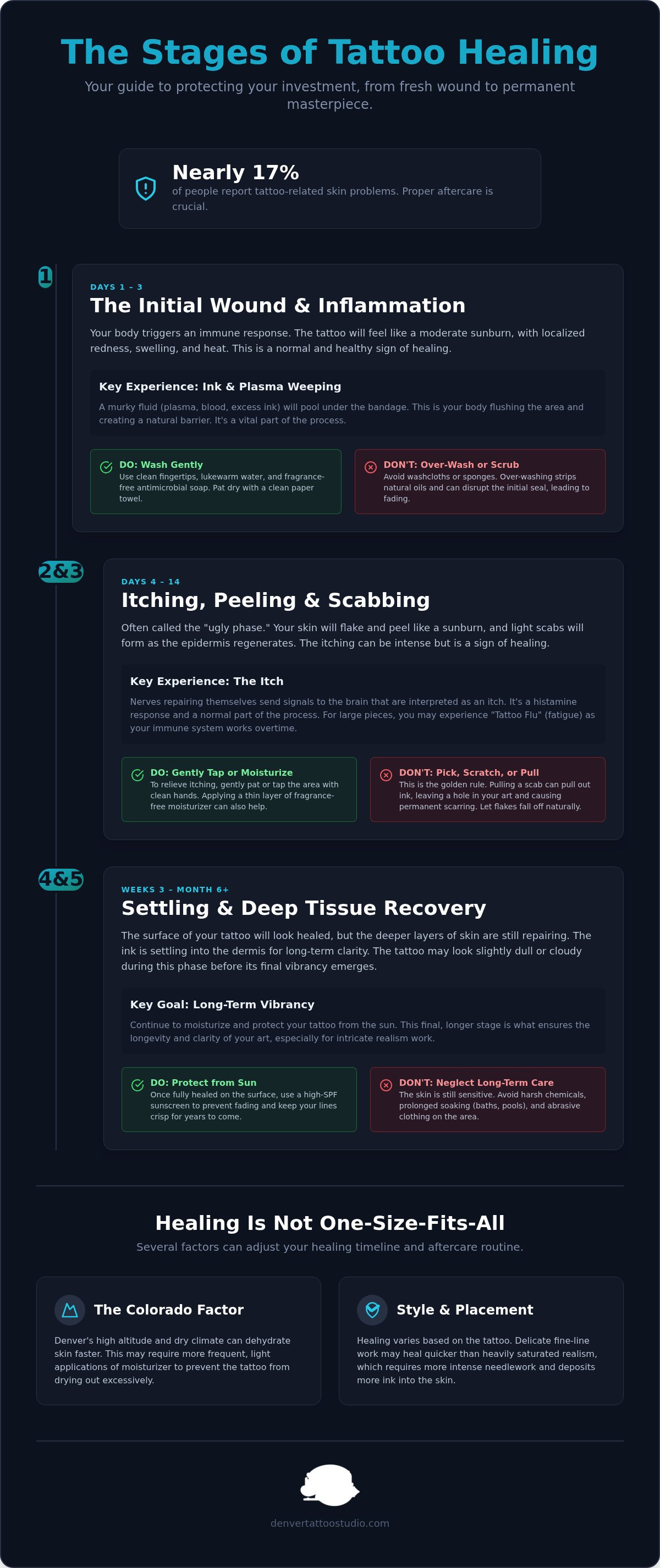
Stage 1: The Initial Wound and Inflammation (Days 1–3)
The moment the needle stops, your body begins a complex immune response. This is the first of the tattoo healing stages, characterized by what professionals call the trauma phase. Because the skin has been breached thousands of times to deposit pigment, your white blood cells immediately rush to the area to begin repairs. Understanding the physiological process of tattooing helps you realize that the heat and swelling you feel aren't necessarily signs of trouble. They're signs of a healthy body protecting a new piece of art.
During these first 72 hours, managing inflammation is your primary goal. You’ll likely notice the area feels like a moderate sunburn. While redness is expected, it should remain localized to the tattoo and the immediate surrounding skin. If the redness begins to spread in streaks or is accompanied by a fever, it's time to consult a professional. Most initial discomfort is just the body's natural reaction to the procedure and the intense focus required during the session.
The Role of Plasma and Ink Weeping
You might notice a murky, dark fluid pooling under your bandage. This is a combination of plasma, blood, and excess pigment, often referred to as "ink shivering." Your body is attempting to flush out foreign material and seal the wound. It’s a vital part of the process that creates a natural barrier. When it's time to clean the area, use lukewarm water and a fragrance-free, antimicrobial soap. Use your clean fingertips only. Avoid washcloths or sponges, as they're too abrasive for this delicate stage. Our master artisan tip is simple: over-washing in Stage 1 strips away the body's natural oils and disrupts the initial seal, which often leads to premature fading and loss of detail.
Managing the First Night of Sleep
The first night is often the most stressful for new clients. If you're using a traditional wrap, your tattoo may leak through, causing it to stick to your bedsheets. Don't pull the fabric away if this happens. Instead, take the sheet with you to the shower and use cool water to gently soak the fabric until it slides off. Many modern studios now use second-skin medical bandages like Saniderm. These are excellent for trapping the body's natural healing fluids, but they can be prone to leaking if the tattoo is large or in a high-motion area. If your bandage leaks or the seal is broken, remove it gently under running water and transition to traditional aftercare. Protecting the integrity of the wound during this window is the best way to prevent heavy scabbing later in the tattoo healing stages.
Stage 2 & 3: The Itching, Peeling, and Scabbing Phase (Days 4–14)
Around day four, the initial swelling subsides and the "ugly phase" begins. This period is often the most visually alarming of the tattoo healing stages. Your skin might look like it's shedding or as if the ink is literally falling off in large flakes. This is a natural part of the recovery process. The epidermis is regenerating, pushing old, pigment-stained cells to the surface. It’s vital to distinguish between this light, paper-thin flaking and "pitting" scabs. Pitting occurs when a thick, hard scab forms and seems to sink into the skin. This often happens in areas of heavy saturation or if the artist worked the skin more deeply to achieve specific realism effects.
The Golden Rule during this window is absolute: never pick or pull at a flake or scab. If you pull a scab that is still attached to the dermis, you risk pulling out the pigment with it, leaving a literal hole in your custom art. For those undertaking large-scale realism or multi-session pieces, you might also experience "Tattoo Flu." This is a state of fatigue and mild malaise as your immune system works overtime to heal a large surface area. Rest and hydration are your best allies here. If you’re planning a complex piece, it’s often helpful to schedule a tattoo consultation to discuss how your specific design might impact your recovery timeline.
Winning the War Against the Itch
The intense itching you feel is a common histamine response. As the skin repairs itself, nerves send signals that the brain interprets as an itch. Scratching is the fastest way to introduce bacteria or cause permanent scarring. Instead, use the "tap" method: gently pat the area with clean hands to provide relief without abrasion. Applying a light, cold compress for a few minutes can also dull the sensation. When selecting a moisturizer, look for fragrance-free, medical-grade options. Following evidence-based tattoo aftercare practices means avoiding petroleum-heavy products that can suffocate the skin and trap heat.
When Scabbing Becomes a Concern
While some scabbing is expected, heavy or "bubbling" scabs are a warning sign that you might be deviating from the optimal tattoo healing stages. Bubbling usually indicates over-moisturization. If you apply too much lotion, the scab absorbs the moisture and softens, making it prone to rubbing off prematurely. This can lead to patchy saturation in your final piece. If a scab gets caught on clothing, don't rip it away. Soak the area in lukewarm water until the fabric releases naturally. A well-healed tattoo requires a delicate balance of moisture: enough to prevent cracking, but not so much that the skin cannot breathe.
Why Healing Varies by Tattoo Style and Placement
Healing isn't a uniform experience for every client. The complexity of your design and its location on your body dictate the rhythm of the Tattoo Healing Process. While a small walk-in tattoo might settle quickly, intricate realism requires a more disciplined approach. Different styles interact with the skin's layers in unique ways, which directly influences how you progress through the tattoo healing stages. A fine-line piece involves minimal trauma and often skips the heavy scabbing phase entirely. Conversely, pieces with heavy saturation require more passes with the needle, leading to more significant inflammation and a longer recovery window.
Black and grey realism presents a specific challenge. These designs rely on soft gradients and subtle shadows to create depth. If you pick a scab or allow the skin to dry out in a shaded area, you risk losing the very transitions that make the art look three-dimensional. Multi-session projects add another layer of complexity. This requires a steady hand and a clear understanding of your body’s limits to ensure you move through the tattoo healing stages without compromising the existing work. You're essentially managing the deep-tissue recovery of "old" ink while simultaneously treating a fresh wound.
The Realism Recovery Challenge
Realism demands a gentler touch to preserve the artist’s meticulous detail. At Denver Tattoo Company, Jason Oz leverages over 20 years of industry expertise to minimize skin trauma during the application. This precision is vital because high-detail work is more susceptible to ink fallout if the healing environment isn't perfect. In high-movement areas, there's also a risk of blowout during the inflammatory phase. This happens when the ink spreads beyond its intended lines due to excessive swelling or strain. Using refined techniques ensures that the skin remains receptive and heals with the clarity intended during the initial consultation.
High-Movement vs. Low-Movement Areas
Where you place your art changes the rules of aftercare. Tattoos on the inner arm or thigh usually heal faster because the skin stays relatively still. Joints and extremities like elbows, knees, hands, and feet are different. These areas are constantly stretching, which can cause scabs to crack and bleed. Adjusting your activity level based on the location of your new art is a sign of respect for the craft and your own body's recovery process.
- Joints: These areas require more frequent, thinner applications of moisturizer to maintain elasticity and prevent the skin from splitting.
- The Torso: Rib and stomach tattoos are affected by every breath you take, necessitating loose clothing to avoid constant friction.
- Extremities: Hands and feet are exposed to more bacteria and environmental friction, requiring extra vigilance during the first 14 days.
The Colorado Factor: Healing Tattoos in High Altitude and Dry Air
Living in the Mountain West introduces environmental variables that most generic aftercare guides simply ignore. In a high-altitude, semi-arid climate like Denver's, your skin behaves differently than it would at sea level. This environmental pressure directly impacts the duration and intensity of the tattoo healing stages. While a standard thin layer of lotion is the universal advice, that layer often evaporates in minutes in our dry air. This leaves your new art vulnerable to cracking and premature scabbing, which can compromise the fine details of a custom realism piece.
Hydration must happen from the inside out. In Englewood and the surrounding metro area, your body loses moisture faster through respiration and perspiration. Increasing your water intake is just as vital as any topical ointment. If you're dehydrated, your skin loses its elasticity, making the "ugly phase" of peeling significantly more uncomfortable. If you're planning a large-scale piece and want to discuss environmental protection for your specific skin type, we invite you to book a tattoo consultation at our studio to ensure your recovery plan is as custom as your art.
Combatting Arid Air
The debate between wet healing and dry healing takes on a different tone in Colorado. Dry healing, or letting the tattoo breathe with minimal intervention, is often too risky here because the air is simply too thirsty. We often recommend a modified wet healing approach where the skin is kept consistently, yet lightly, hydrated. Using a humidifier in your bedroom can provide a massive advantage during the first 14 days. Look for aftercare products containing ingredients like shea butter or specific natural oils that create a breathable barrier. These help lock in moisture without suffocating the pores, which is essential for maintaining the soft gradients in black and grey work.
Sun Safety in the Mile High City
At 5,280 feet, the atmosphere is thinner, providing less protection from ultraviolet rays. A fresh tattoo is essentially a controlled wound, and UV exposure during the initial tattoo healing stages can cause the pigment to break down before it even settles. Fresh ink is extremely susceptible to sunburn, which can lead to blistering and permanent scarring. We follow a strict three-month rule: no direct sun and no sunscreen on the area until the deep tissue has fully recovered. If you're heading out for a day in Highlands Ranch or Lakewood, rely on loose, UV-protective clothing rather than topical creams. This protects the integrity of the pigment while allowing the skin to continue its natural respiratory process.
Seasonal shifts also require adjustments. Winter in Colorado is notoriously harsh on the skin, often requiring a slightly more frequent application of moisturizer to prevent the "tight" feeling that leads to cracking. Summer requires more vigilance against heat and sweat, which can harbor bacteria. By respecting the local climate, you ensure that the veteran artistry of Jason Oz remains as sharp and vibrant as the day it was applied.
Stage 4 & 5: Settling and Deep Tissue Recovery (Weeks 3–Month 6)
By the third week, the visible drama of the "ugly phase" has typically passed. Your skin no longer flakes, and the intense itching has subsided. However, this is one of the most deceptive tattoo healing stages. Many people believe their recovery is complete at this point, but the biological work has simply moved beneath the surface. You may notice your art looks slightly shiny or has a waxy, plastic-like texture under certain lights. This is often called the "onion skin" phase. It occurs because the newly formed epidermis is still very thin and hasn't yet regained the natural matte texture of mature skin.
During this period, the deeper layers of your skin are still in a state of active remodeling. While the surface feels smooth, the dermis is working to stabilize the pigment and repair the microscopic channels created by the needle. It takes approximately six months for the tissue to fully settle and for the ink to become a permanent, integrated part of your anatomy. This is when the clarity and depth of your custom realism truly begin to shine. If you notice any concerns during this transition, the team at Denver Tattoo Company is available to evaluate the progress of your piece.
The Maturation of Pigment
The science of ink settling is a slow, methodical process. Your immune system uses specialized cells called macrophages to "trap" the pigment particles in the dermis. During the first few months, your tattoo might look slightly muted or less vibrant than it did on day one. This is normal. As the skin cells mature and the inflammation deep in the tissue completely dissipates, the ink will regain its intended contrast. Maintaining long-term skin health through consistent hydration and sun protection is the only way to ensure the longevity of these delicate gradients.
Touch-ups and Long-Term Integrity
We adhere to a strict rule of waiting at least 6 to 8 weeks before performing any touch-ups. Attempting to add more ink before the skin has fully regained its structural integrity can lead to unnecessary scarring or "blowouts." During this window, you can accurately identify "holidays," which are small gaps in the ink where the body may have rejected pigment during the scabbing phase. These are distinct from normal healing variations and are easily corrected once the tissue is stable. For complex realism pieces, we recommend annual check-ins to monitor how the fine details are aging against the backdrop of the Colorado climate. This commitment to the work ensures your investment remains a masterpiece for decades, not just years.
Protecting Your Masterpiece for the Long Term
Mastering the tattoo healing stages is a commitment to the longevity of your art. From managing the initial inflammatory response to supporting deep tissue recovery months later, your patience and diligence determine the final clarity of your piece. Environmental factors in the Mountain West require a nuanced approach to hydration, while the complexity of custom realism demands a specialized eye for long-term maintenance and skin health.
When you're ready to invest in a significant piece of body art, the foundation of that work should be built on technical safety and veteran expertise. At Denver Tattoo Company in Englewood, we maintain 100% sterile, single-use equipment standards to protect the integrity of every procedure. Jason Oz brings over 20 years of professional experience to the studio, specializing in the intricate details of custom realism that require a master’s touch to heal perfectly and age beautifully.
Book a Consultation with Jason Oz at Denver Tattoo Company today to begin your collaborative creative process. Your art is permanent; ensure the hands that create it are as dedicated to the recovery as they are to the design.
Frequently Asked Questions
How long does it take for a tattoo to stop being an open wound?
A tattoo typically stops being an open wound within the first 48 to 72 hours as the initial plasma weeping subsides and a protective seal forms. This is the first of the tattoo healing stages where the skin begins to close itself off from environmental contaminants. While the surface feels closed, the deeper layers remain vulnerable for several weeks as the tissue begins its internal repair process.
Is it normal for my tattoo to look dull or cloudy after the peeling phase?
It is completely normal for your art to appear muted or milky immediately following the peeling phase. This occurs because the new layer of skin is still thin and lacks the natural matte texture of mature tissue. As this "onion skin" layer thickens and settles over the next few weeks, the vibrancy and contrast of the pigment will return to the surface.
Can I go to the gym while my tattoo is in the peeling stage?
You should avoid intense gym sessions that involve heavy sweating or direct friction on the tattooed area during the peeling stage. Sweat can harbor bacteria and soften scabs prematurely, while repetitive movement might cause the skin to crack and bleed. If you must exercise, focus on low-impact activities that don't strain the specific location of your new art or cause excessive perspiration.
What should I do if I accidentally scratched or picked my tattoo?
If you accidentally scratch or pick your tattoo, clean the area immediately with fragrance-free antimicrobial soap and lukewarm water. Do not apply extra ointment to compensate, as this can suffocate the wound and cause further issues. Monitor the spot for any pigment loss once it fully heals. A professional touch-up can usually correct any minor gaps in the design once the tissue is stable.
How can I tell if my tattoo is infected or just irritated?
Infection is typically characterized by spreading redness, extreme heat, foul odors, or yellow discharge. Normal irritation usually involves localized redness and itching that subsides within a few days of the procedure. If the redness begins to travel away from the tattoo in streaks or you develop a fever, consult a medical professional immediately to ensure your safety and the integrity of the art.
When is it safe to submerge my new tattoo in water?
You should wait at least three to four weeks before submerging your tattoo in pools, hot tubs, or natural bodies of water. Even if the surface looks healed, the skin hasn't fully regained its barrier function. Chemicals like chlorine and bacteria found in open water can cause severe infections or damage the settling pigment during the later tattoo healing stages.
Does the size of the tattoo change the healing timeline?
The size of your tattoo significantly influences the initial recovery intensity but doesn't change the overall biological timeline. A full sleeve involves more skin trauma and a larger immune response than a small design, often leading to more pronounced fatigue or swelling in the first week. However, both pieces still require the full six-month window for deep tissue remodeling to be considered fully settled.
Why does my tattoo feel raised or bumpy months after it has healed?
Tattoos often feel raised or bumpy months later due to changes in temperature, humidity, or even minor allergic reactions to specific pigment ingredients. In some cases, this texture is the result of slight scarring from the application or improper healing during the scabbing phase. If the bumps are persistent or accompanied by renewed itching, a consultation can help determine if it is an environmental reaction.


