
What if the most important part of your new tattoo isn't the design itself, but the way it moves with your muscle and bone? Choosing the right location for your art is a permanent decision that requires more than just an aesthetic eye. Knowing how to prepare for a tattoo consultation Denver experts suggest begins with looking beyond the ink and considering the unique canvas of your own body. It's natural to feel some anxiety about how a piece might distort over time or whether a specific spot will be too painful to endure.
We understand that you want your investment to look as sharp in twenty years as it does on day one. This guide will help you master the technical and artistic side of tattoo placement to ensure your custom ink ages perfectly, even in the dry Colorado climate. You'll learn how to evaluate the pain scale for different areas and how to choose a location that respects your professional visibility. We'll also explore how anatomical movement influences design longevity, giving you the confidence to collaborate effectively with a veteran artist during your session.
Key Takeaways
- Understand why a technical placement session is essential for aligning your custom art with your body's natural flow.
- Master how to prepare for a tattoo consultation Denver experts suggest by organizing your ideas and choosing the right attire for your appointment.
- Learn how the unique Colorado environment and UV exposure can dictate the best location for long-term ink vibrancy.
- Get a realistic assessment of the pain scale and professional visibility to help you choose a spot with complete confidence.
- Discover how professional expertise helps predict skin shift over time to prevent design distortion as you age.
Tattoo Placement Consultations: Why They Matter
A tattoo is more than a static image; it is a permanent integration into your living anatomy. A specialized placement consultation is a dedicated meeting where we determine the optimal body location for your design based on your specific muscle structure and the long-term integrity of the ink. While a general design consultation focuses on the "what," a technical placement session focuses on the "how." It bridges the gap between a beautiful drawing and a piece of wearable art that moves naturally with your body. When you learn how to prepare for a tattoo consultation Denver professionals can provide better guidance on how your unique physique will interact with the art over time.
Translating a "flat" design from a piece of paper or a digital screen onto a curved, three-dimensional body is a complex task. Muscles, joints, and bone structures create a dynamic canvas that shifts every time you reach, sit, or walk. Our studio relies on over 20 years of industry experience to predict how these skin shifts will affect your tattoo. Expert placement ensures that a portrait doesn't distort when you flex your arm or that a geometric pattern remains symmetrical during movement. This technical foresight is what separates a standard tattoo from a custom piece that feels like a natural extension of your form.
The Science of Skin and Ink
Understanding the tattooing process requires a look beneath the surface at the dermis, the layer of skin where ink permanently resides. Different body areas have varying skin thicknesses and concentrations of collagen and elastin. High-motion areas, such as the wrists, elbows, and feet, undergo constant stretching and friction. These factors require specific design considerations, as the skin in these zones tends to regenerate faster or experience more "blur" over decades. By analyzing your skin's elasticity and the location's typical wear, we can adjust line weights and shading to maintain crispness for the long haul.
Avoiding Common Placement Mistakes
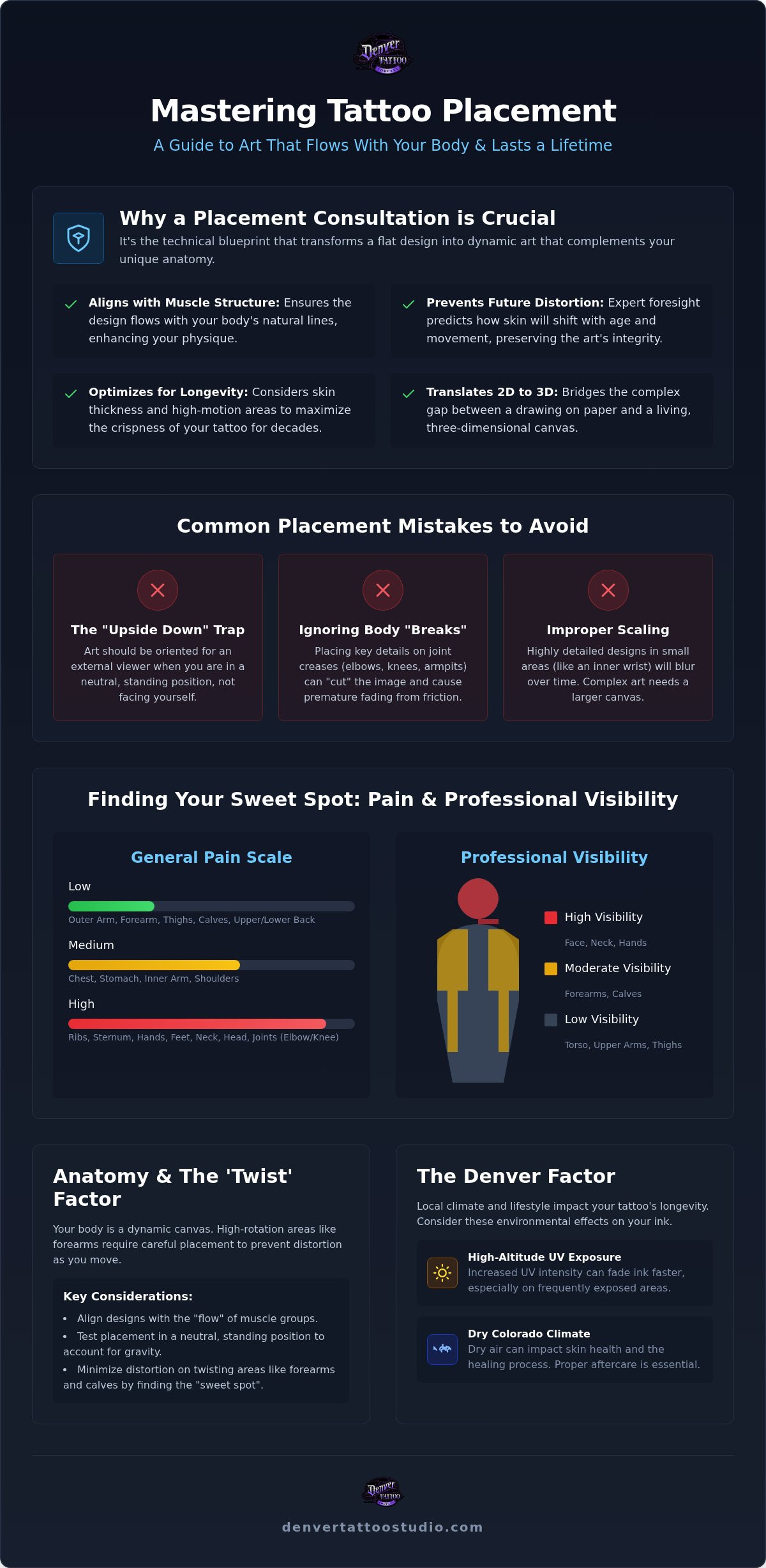
One frequent hurdle is the "upside down" orientation trap. While it's tempting to want a forearm tattoo to face you, standard professional practice dictates that art should be oriented toward the viewer when your body is in a neutral, standing position. This ensures the piece looks intentional and balanced to the world. We also look for natural body "breaks," such as the creases of your joints or the fold of an armpit. Placing a focal point of a design directly on a joint can "cut" the image and cause premature fading. Finally, scaling is vital. A highly detailed design placed in a small area like the inner wrist will eventually lose its definition as the ink spreads slightly over time. Choosing a larger canvas or simplifying the detail ensures the work remains legible for life.
Anatomy and Movement: How Your Body Dictates Design Flow
Your body is not a flat, static page; it is a collection of curves, kinetic energy, and shifting planes. When you are learning how to prepare for a tattoo consultation Denver artists often emphasize that the design must flow with your musculature to remain aesthetically pleasing. Jason Oz brings over 20 years of industry experience to this process, allowing him to visualize how a stencil will shift once you move from a seated position to a natural stride. This foresight is critical for preventing "warping," a common issue where a perfectly straight line on a stencil becomes a distorted curve once applied to the skin. We view your body as a living canvas that requires a master artisan’s eye to navigate correctly.
Designing for "flow" means aligning the primary lines of a tattoo with the natural contours and "landscape" of your muscle groups. For example, a sleeve should wrap in a way that accentuates the bicep or forearm rather than cutting across it awkwardly. We always judge final placement while you are standing in a neutral position. Gravity affects skin tension and fat distribution differently than when you are reclining or sitting, making the standing posture the only reliable way to ensure symmetry and balance. This collaborative step ensures the art feels like a natural extension of your form.
The 'Twist' Factor in Arm and Leg Tattoos
The forearm is perhaps the most deceptive area for tattoo placement. The radius and ulna bones impact skin rotation during a consultation by shifting the surface tension as the arm moves, which can alter the appearance of straight lines or portraits significantly. A design placed on the inner forearm might look centered when your palm is up but become skewed when your hand is at your side. During your consultation, we test these rotations to find the "sweet spot" where distortion is minimized. Similar logic applies to calf tattoos, where the gait of your walk can cause the design to expand and contract. To ensure the highest standards of care, we always follow FDA tattoo safety guidelines regarding ink and skin health during the application process.
Torso and Back: Managing Large-Scale Canvas
Large-scale canvases like the back or torso offer incredible freedom but present unique challenges. Centering a design on the spine provides a sense of classical stability and power, while asymmetrical placement can create a more dynamic, modern look that follows the sweep of the ribs or shoulder blades. It is also vital to consider how breathing and posture affect these areas. A stomach tattoo will move with every breath, and rib pieces are subject to significant skin stretching. If you are planning for future muscle gain or lifestyle changes, we can adjust the placement to ensure the art remains proportional. Understanding these nuances is a key part of our tattoo consultations, where we work together to make your vision a permanent reality.
The Denver Factor: How Local Climate and Lifestyle Affect Placement
Living at 5,280 feet offers breathtaking views, but it also presents a unique set of challenges for your skin. When you are learning how to prepare for a tattoo consultation Denver’s intense UV index and famously dry air should be top of mind. High-altitude sun exposure is significantly more aggressive than at sea level. This means tattoos on high-exposure areas like the back of the neck or the tops of shoulders can age prematurely if not placed with care. We often guide clients in Englewood and Littleton to consider how their outdoor hobbies, such as hiking with heavy packs or wearing restrictive ski gear, might interfere with a fresh tattoo's recovery. A placement that looks great in the mirror might be a liability if it sits directly under a backpack strap during your weekend trips to the mountains.
Our studio maintains a sterile, professional environment that strictly adheres to OSHA's Bloodborne Pathogens Standard, providing a safe foundation for your new art. However, once you leave the chair, the Colorado climate takes over. Arid air can cause skin to lose moisture rapidly, which often leads to tighter scabbing and potential cracking in high-friction zones like the inner elbow or knee. Choosing a placement that minimizes this environmental stress is a collaborative decision we make during your session to ensure your investment remains sharp. We want your ink to withstand the elements just as well as you do.
Sun Exposure and Ink Longevity
UV rays act as a catalyst that breaks down ink pigments within the dermis over time. In our high-altitude environment, this process is accelerated because there is less atmosphere to filter out damaging radiation. For collectors who want vibrant color or high-contrast black and grey realism, we may suggest "hidden" placements that stay protected by clothing during peak sun hours. This strategy preserves the saturation and fine detail that defines our work, preventing the "bleached" look that can occur after years of mountain adventures. Contrast retention is the key to a tattoo that looks professional for decades.
Healing in a High-Altitude Environment
Managing a new tattoo during a busy commute or a weekend trip to the high country requires a strategic placement. Joints in Denver need extra hydration during the first two weeks to prevent the skin from splitting in the dry climate. We also address "Tattoo Flu," a systemic fatigue some beginners feel after a long session. At high altitude, your body is already working harder to oxygenate your blood, so choosing a placement that allows for easy, frequent aftercare application is essential for a smooth recovery. We'll help you find a spot that balances your aesthetic goals with the practical realities of Colorado life.
Pain, Visibility, and Professionalism: Choosing Your Spot
While technical factors like anatomy and climate determine how a tattoo physically ages, your personal lifestyle determines how you live with it every day. When you are learning how to prepare for a tattoo consultation Denver artists will often ask you to consider the balance between your aesthetic goals and your daily reality. Choosing a location involves a psychological trade-off between where a design looks best and how much visibility you are comfortable with in your professional life. We believe the most successful tattoos are those that align with your career trajectory and your personal threshold for physical discomfort. This decision is a collaborative one, ensuring you feel confident in your skin for decades to come.
For those embarking on their first project, we often recommend a placement that balances manageable pain with high visibility. Seeing your art daily can strengthen your connection to the piece, but choosing an area with extreme sensitivity might make the initial experience more stressful than necessary. We use a realistic pain scale to help you navigate these choices. Fleshy areas with fewer nerve endings generally offer a smoother experience, while spots where the skin is thin or directly over bone require more mental fortitude. Understanding these sensations ahead of time allows you to arrive at your session focused and relaxed.
The Pain Map for Beginners
Low-pain zones typically include the outer arm, the thigh, and the upper back. These areas provide a stable, relatively "quiet" canvas for a first experience. Conversely, high-intensity zones include the ribs, the feet, and the sternum, where the proximity of bone to the skin surface amplifies the vibration of the machine. The ditch refers to the sensitive inner crease of the elbow or the back of the knee, and it remains a high-intensity placement reserved for experienced collectors due to its thin skin and high concentration of nerve endings. We'll discuss these sensations during your session so you can choose a spot that feels right for your experience level.
Visibility and Career in the Front Range
The "T-shirt line" remains a gold standard for many professionals in the Denver metro area. This rule ensures that your ink is easily hidden by a standard short-sleeved shirt, allowing you to control when and where your art is seen. While Denver’s culture is notably relaxed and creative, corporate expectations in Englewood and Highlands Ranch can still vary by industry. Strategic placement on the upper arm, shoulder, or thigh allows you to enjoy large-scale custom work that stays private during office hours but can be shown off at the gym or the pool. We help you navigate the "job stopper" debate by finding placements that respect your career path without compromising your artistic vision.
Ultimately, the relationship you have with your tattoo is personal. Some collectors prefer public art that serves as a conversation starter, while others view their tattoos as a private narrative. Whatever your preference, we are here to provide the technical expertise and professional guidance needed to make it a reality. Ready to discuss your placement with a professional? Book your tattoo consultation with our team today to start your next project.
Start Your Project at Denver Tattoo Company: What to Expect
Your journey toward a permanent piece of custom art begins with a structured conversation. Booking a dedicated placement consultation with Jason Oz at our Englewood studio ensures that your vision receives the technical scrutiny it deserves. When you are looking at how to prepare for a tattoo consultation Denver artists recommend arriving with a clear set of reference photos. These images serve as a starting point; however, we ask that you maintain an open mind. Our goal is to listen to your creative objectives while providing the technical guardrails necessary for a tattoo that looks exceptional for decades. We don't just apply ink; we verify the fit of the art to your specific anatomy.
During our meeting, we move from the conceptual to the physical by using stencils to "test drive" your placement. This step is vital. It allows you to see how the design interacts with your muscle movements and skin tension before the tattooing process begins. We might adjust the scale or slightly shift the angle to ensure the flow is perfect. This collaborative process removes the guesswork, giving you a clear preview of the final result. We want you to feel entirely comfortable with the orientation and size before we commit to the permanent work. It's a methodical approach that reflects our commitment to precision.
Preparation for Your Englewood Consultation
Preparing the "canvas" is just as important as preparing the design. In the days leading up to your visit, focus on skin hydration and overall health. Well-hydrated skin accepts ink more readily and heals more efficiently, especially in our dry climate. Understanding how to prepare for a tattoo consultation Denver experts suggest also involves thinking about your "why." The emotional significance of a piece often dictates its final location. For instance, a memorial might feel most appropriate over the heart, while a symbol of personal strength might belong on a visible area like the forearm. To learn more about this journey, explore our perspective on Collaborative Tattoo Design: From Concept to Skin. Please also wear clothing that allows easy, comfortable access to the area you're considering.
Safety and Professionalism in Our Studio
Our commitment to your well-being is the foundation of our craft. We maintain a high-standard, sterile environment by using single-use sterilized equipment for every consultation and tattooing session. This discipline ensures that your experience is as safe as it is creative. For residents of Lakewood and Littleton, our studio offers a sophisticated alternative to the typical shop experience. Jason Oz’s 20 years of veteran expertise provides a steady hand and a reliable authority you can trust. We take the permanence of our work seriously, emphasizing artistic integrity in every line. Schedule your professional tattoo consultation at Denver Tattoo Company today and take the first step toward your next custom piece.
Secure Your Vision with Expert Placement
Choosing the right location for your art is a decision that balances anatomical flow, environmental resilience, and personal comfort. We've explored how Denver’s high UV index and dry climate require a strategic approach to ensure your ink remains vibrant for decades. By considering your professional visibility and understanding the technical movement of your skin, you can approach your session with absolute confidence. Our studio in Englewood provides a safe, sterile environment where over 20 years of veteran experience is applied to every custom design and black and grey realism piece.
Knowing how to prepare for a tattoo consultation Denver experts recommend is the first step toward a collaborative and successful project. We invite you to bring your ideas and your questions to a space dedicated to the highest standards of the craft. Let's work together to ensure your tattoo is a perfect reflection of your story and a natural extension of your body. Book Your Custom Placement Consultation with Jason Oz today. Your next masterpiece deserves a steady hand and a master's eye.
Frequently Asked Questions
What is the least painful place to get a tattoo for a first-timer?
The outer arm, thigh, and upper back are generally considered the least painful areas for a first tattoo. These zones have thicker skin and more muscle or fat, which helps cushion the sensation of the needle. Choosing one of these fleshy areas provides a smoother introduction to the process. It allows you to build confidence before considering more sensitive spots like the ribs or feet.
Will my tattoo stretch if I gain weight or build muscle?
Most tattoos will not distort significantly with moderate muscle gain or weight changes. Your skin is remarkably elastic and typically scales the artwork proportionately as your body shape shifts. Rapid or extreme changes can occasionally cause minor stretching, but professional placement accounts for your natural anatomy. We position designs to ensure they maintain their integrity even as you stay active and grow over time.
How do I know if a design is too big for the area I want?
We determine the appropriate scale by applying a stencil to your body during the technical placement session. If a design wraps too far around a limb or crosses over a joint in a way that cuts the image, it is likely too large for that specific spot. A professional artist ensures the focal point remains visible from a neutral standing position. This prevents the art from looking cluttered or distorted.
Does the Colorado sun really fade tattoos faster?
Yes, the high UV index at Denver's 5,280-foot elevation breaks down ink pigments much faster than at sea level. The thinner atmosphere provides less protection against solar radiation, which can lead to premature fading and blurring. This is why we often suggest placements that are naturally shielded by clothing. Protecting your investment from the intense Front Range sun is essential for maintaining long-term contrast and detail.
Can I get a tattoo over a scar or birthmark during a placement consultation?
Tattooing over scars is often possible, provided the tissue is fully healed and has matured for at least one year. During your session, we evaluate the texture and thickness of the scar to ensure it can safely hold ink. Birthmarks are generally avoided to allow for ongoing medical monitoring. We work with you to find a placement that either incorporates or camouflages these areas while prioritizing your skin health.
How much does a tattoo consultation cost in Denver?
Many professional studios in the metro area provide consultations as a collaborative first step to discuss your project. You should always verify the specific policy with your chosen artist when you book. These sessions are focused on technical safety and design flow rather than a simple transaction. Learning how to prepare for a tattoo consultation Denver experts recommend ensures you get the most value out of this professional meeting.
What should I wear to my tattoo placement consultation?
You should wear loose, comfortable clothing that allows easy access to the area you want tattooed. For example, shorts are ideal for leg placements, while a tank top is best for shoulder or arm work. This is a practical part of how to prepare for a tattoo consultation Denver artists appreciate. Being able to see the skin and apply a test stencil directly to the area is vital for an accurate assessment.
How do I decide between a visible or hidden tattoo placement?
The choice depends on your daily environment and how much you want to share your art with others. If you work in a conservative professional setting, staying above the "T-shirt line" or choosing the torso allows for total discretion. Conversely, many collectors in Denver’s creative culture prefer visible placements like the forearm. We help you weigh these lifestyle factors against your aesthetic goals to find a spot that feels right.


