
A stunning Instagram feed is often a poor indicator of how a tattoo will actually look in five years. You've likely spent hours scrolling through social media, feeling both inspired and overwhelmed by the sheer volume of work available. It's easy to get lost in artistic style while overlooking the technical precision that ensures a piece remains crisp as it ages. Conducting a thorough tattoo artist portfolio review Denver is about more than just finding a pretty picture; it's a technical audit of an artist's ability to saturate ink, pull steady lines, and respect the anatomy of the skin.
We understand the anxiety that comes with committing to permanent art, especially when filtered photos can mask underlying flaws. You deserve to feel confident that your investment is in the hands of a disciplined master artisan who values longevity over social media trends. This article provides you with a professional framework for evaluating portfolios to ensure your next piece is technically sound and built to last. We'll walk through a clear vetting checklist, explain the vital difference between fresh and healed work, and help you prepare for a collaborative consultation with a seasoned expert.
Key Takeaways
- Identify critical technical markers like line consistency and color saturation to ensure your design remains crisp and well-defined for years to come.
- Learn why a professional tattoo artist portfolio review Denver must prioritize healed images over fresh, filtered photos to accurately judge an artist's true skill.
- Understand how to distinguish between a unique signature style and inconsistent work to find a dedicated specialist who can execute your specific vision.
- Discover how to use a collaborative consultation to bridge the gap between a digital portfolio and a custom piece tailored perfectly to your anatomy.
Why a Tattoo Artist Portfolio Review is Essential in the Denver Market
Denver has established itself as a premier destination for custom body art, with a high concentration of talent spanning from the city center to Englewood. While this abundance of choice is a benefit for collectors, it creates a significant challenge for those seeking their first piece or a complex custom design. A comprehensive tattoo artist portfolio review Denver is your primary defense against the long-term regret of a technically flawed piece. Without a disciplined approach to vetting, you risk more than just a stylistic mismatch; you risk the physical and financial burden of expensive laser removal or complex cover-ups later on.
A professional portfolio serves as a resume of technical mastery and artistic integrity. It's the foundation of trust between you and the practitioner. Before booking a session, it's helpful to learn about the tattoo artist profession to understand the rigorous training and technical standards required for permanent work. This knowledge allows you to move beyond surface-level aesthetics and evaluate the actual health and longevity of the art.
The Saturation of the Colorado Tattoo Scene
The Colorado tattoo landscape is diverse, ranging from high-volume "street shops" that prioritize walk-in turnover to dedicated custom studios focused on intricate, collaborative projects. Choosing an artist based solely on proximity to your home or the lowest price point is a common mistake that often leads to poor results. Professional standards vary wildly across the region. A master-level artist in a custom environment treats every piece as a permanent legacy, whereas a less experienced practitioner might prioritize speed over skin health. You aren't just buying a design; you're investing in the technical safety and the specific expertise of a seasoned expert who understands how ink behaves in the skin over decades.
Portfolio vs. Social Media: Understanding the Difference
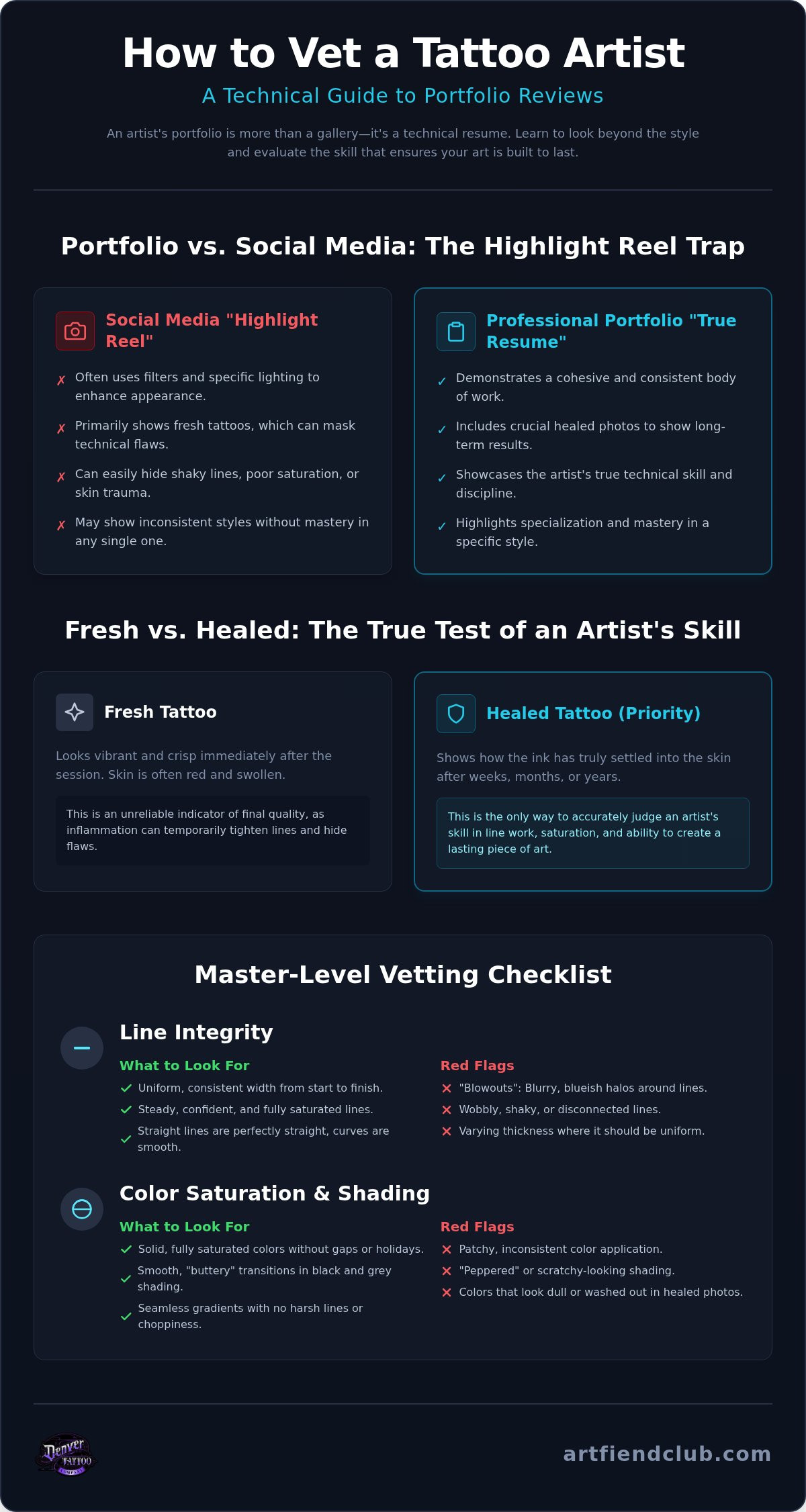
Social media platforms like Instagram have become powerful tools for artists, but they're often a "highlight reel" rather than a true representation of daily work. Filters, specific lighting, and fresh-only photos can easily mask shaky lines or poor saturation. A curated website portfolio typically carries more weight because it demonstrates a cohesive body of work. When reviewing an artist, look for consistency across multiple pieces rather than a few "one-off" hits. You want to see an artist who specializes in your desired style, whether that's traditional, realism, or fine line. If an artist's work jumps erratically between unrelated styles without technical proficiency in any of them, it's often a sign they haven't yet mastered the discipline required for high-end custom work.
Key Technical Markers of a Master-Level Tattoo Portfolio
Technical proficiency isn't subjective. While artistic style is a matter of personal preference, the execution of a tattoo follows strict mechanical rules that dictate how well a piece will heal and age. When conducting a tattoo artist portfolio review Denver, you're looking for evidence of technical discipline and hand control. A master artisan understands that the skin is a living, changing canvas that requires precise needle depth and pressure. Failure to maintain these standards can lead to permanent skin damage or illegible art. Reviewing FDA information on tattoo safety highlights the necessity of choosing a professional who adheres to high technical standards to ensure the long-term health of your skin.
Evaluating Line Integrity
Lines are the foundation of almost every tattoo. They should be uniform in width and saturated from start to finish. Zoom in on digital photos to check for "blowouts," which appear as a blueish, blurry shadow around the line where the ink was pushed too deep into the fatty tissue. Conversely, shaky lines or "wobbles" suggest a lack of hand stability or poor machine calibration. In geometric or fine-line work, the "straight line test" is essential. If a line that's meant to be perfectly straight looks like a series of connected dots or has varying thicknesses, it won't hold its shape over time. Consistent line weight is vital because all tattoos spread slightly as the body ages; a line that's already inconsistent will only look more distorted a decade later.
Color and Value Gradation
Shading should feel like a smooth, seamless mist rather than a collection of distinct scratches. In black and grey realism, look for "buttery" transitions between light and dark areas. Choppy or "peppered" shading often indicates that the artist was too aggressive or didn't use the correct needle grouping for the task. Saturation is equally important in color work. In traditional or neo-traditional styles, pigment should be packed solid. If you see "holidays," which are tiny gaps where the natural skin tone shows through the pigment, the artist didn't achieve full saturation. High-contrast values are the secret to longevity. Without a clear distinction between the deepest blacks and the brightest highlights, a tattoo will eventually settle into an indistinct grey mass.
A great tattoo also respects the body's natural curves and muscle structure. Look at how a large piece wraps around a limb or follows the arch of a shoulder. If the design feels "stuck on" like a sticker rather than integrated with the wearer's anatomy, it lacks professional foresight. Mastering these technical markers is the first step toward a successful custom piece. If you're ready to see these standards in practice, you might consider booking professional tattoo consultations to discuss your specific vision with a seasoned expert who prioritizes technical precision.
Fresh vs. Healed: Decoding the Denver Tattoo Instagram Trap
A fresh tattoo is essentially an open wound, characterized by redness, swelling, and a superficial vibrancy that will inevitably change as the skin repairs itself. While these photos look striking on social media, they don't represent the final version of the art that you'll wear for the rest of your life. When you perform a tattoo artist portfolio review Denver, you must look beyond the immediate impact of a newly finished piece. A healed tattoo, typically photographed three months to a year after the session, reveals the true technical skill of the artist. It shows how the ink has settled into the dermis and whether the lines have remained crisp or started to blur into the surrounding tissue.
The absence of healed work in a professional portfolio is a significant red flag. It often suggests that an artist isn't seeing their clients return or that their technical execution doesn't stand the test of time. A master artisan who is confident in their craft will proudly display work that has fully settled, as this transparency is the only way to prove the longevity of their custom designs.
How to Spot Edited Portfolio Photos
Digital editing tools can easily mask technical flaws like minor scarring or inconsistent saturation. You can often spot over-saturated photos by looking at the surrounding skin; if the skin looks unnaturally white or the blacks appear like deep, textureless voids, the contrast has likely been manipulated. Many artists also use polarizing lenses to remove the natural glare from fresh ink, which makes a new tattoo look as flat and settled as a healed one. To get an honest view, look for photos taken in natural lighting. These images might not look as "perfect" as studio-lit shots, but they provide a much more accurate representation of how the work interacts with the texture of real skin.
The Importance of Healed Results in Colorado
The environmental conditions in Englewood and the greater Denver area present unique challenges for tattoo longevity. Our high altitude and notoriously dry climate can be harsh on healing skin, making technical precision even more vital. A master artist like Jason Oz, with over 20 years of experience, prioritizes the "five-year look" over the "one-day look." This philosophy ensures that the design is applied with the correct needle depth to withstand the elements. Proper aftercare is a collaborative effort, and understanding Long-Term Tattoo Care in Colorado is essential for preserving your ink against UV exposure and dehydration. When you review a portfolio, you're looking for evidence that the artist understands these regional factors and creates work that remains beautiful despite the local environment.
Evaluating Style Consistency and Custom Design Capability
Style isn't just about aesthetics; it's a reflection of technical repetition and mastery. When you're conducting a tattoo artist portfolio review Denver, you're looking for a clear "signature" that suggests the artist has spent years perfecting a specific discipline. An artist who jumps erratically between unrelated styles, like traditional Americana one day and hyper-realistic portraits the next, might lack the deep technical nuances required for a high-end custom piece. Consistency in a portfolio proves that the artist's results are predictable and repeatable, which is essential when you're trusting someone with a permanent addition to your body.
A disciplined tattoo artist portfolio review Denver focuses on identifying this level of consistency. You should look for a cohesive body of work that demonstrates a mastery of line weight, shading logic, and color theory within a specific niche. If the artist claims to be a specialist in black and grey realism, their portfolio should show dozens of examples that all share a similar level of smooth gradation and high-contrast value. This repetition is the hallmark of a master artisan who has moved beyond basic application and into true creative fulfillment.
Specialization vs. Generalization
The Denver market is full of "street shops" that handle a wide variety of walk-in requests, but serious collectors often seek out "tattoo-only" studios for more complex work. These focused environments allow artists to dedicate their entire practice to the craft without the distractions of adjacent services. This level of focus is often visible in the portfolio through the complexity and scale of the projects. You can learn more about Why Specialization Matters for Your Ink to understand how a narrow focus leads to higher technical quality and better skin health outcomes.
Custom Artistry and Collaborative Design
There is a fundamental difference between a "tracer" and a "creator." A tracer's portfolio is often filled with "flash" or copied artwork that lacks original composition or anatomical flow. In contrast, a creator's portfolio showcases Custom Tattoo Designs Denver that are specifically tailored to the individual client. These pieces show an ability to interpret a story and translate it into a visual language that works with the natural curves of the body. When reviewing custom work, look for large-scale, multi-session projects like full sleeves or back pieces. These indicate that the artist can maintain technical and stylistic consistency over many months of work, which is a vital skill for any serious custom project.
If you're ready to move beyond digital portfolios and start your own creative journey, we invite you to request a custom tattoo consultation to discuss your vision with a seasoned expert who values technical precision and collaborative artistry.
Collaborative Consultations at Denver Tattoo Company: Beyond the Portfolio
A digital vetting process is an essential first step, but it's only half of the equation. A thorough tattoo artist portfolio review Denver should lead you directly to a face-to-face conversation where the artist's vision and your personal story align. At Denver Tattoo Company, we view the consultation as the bridge between a static image and a living piece of art. It's during this collaborative session that we move beyond aesthetics to discuss the technical realities of placement, skin texture, and long-term ink behavior. This transition from screen to skin is where professional expertise becomes truly tangible.
Jason Oz brings over 20 years of industry experience to every meeting, emphasizing a philosophy where technical precision meets artistic vision. He believes in radical transparency regarding healed expectations. While a portfolio shows what is possible, a consultation determines what is optimal for your specific anatomy. This honest dialogue ensures that the final result isn't just a copy of a previous work, but a custom masterpiece built to withstand the test of time. We prioritize this stage of the process because it establishes the mutual trust necessary for a successful, permanent collaboration.
What to Bring to Your Denver Consultation
Preparing for your visit to our Englewood studio helps maximize the time spent with your artist. Bring specific references from the artist's portfolio that resonate with you; this helps communicate your aesthetic preferences more clearly than words alone. Whether it's the specific line weight of a previous piece or the value gradation in a portrait, these visual cues are invaluable. You should also review our guide on What to Ask During a Tattoo Consultation to ensure you're covering all technical and logistical bases. We'll take your inspiration and translate it into a technically sound custom design that respects the integrity of your skin.
The Master Artisan Approach
Our dedication to the craft is reflected in our controlled, tattoo-only environment. By specializing exclusively in custom body art, we maintain a focused atmosphere that prioritizes the individual's experience and the permanence of the work. This commitment extends to our rigorous safety protocols, including the use of sterile, single-use equipment and premium inks selected for their longevity. You can learn more about our standards by reading about a Safe Tattoo Studio Denver. With over two decades of experience, Jason Oz ensures that every portfolio review ends with a piece of art that is as safe as it is beautiful. We invite you to visit us in Englewood to experience a collaborative process that treats your skin with the respect it deserves.
Securing Your Permanent Legacy
Choosing the right artist is an investment in your future self. By mastering a tattoo artist portfolio review Denver, you've moved beyond the superficial allure of filtered social media feeds. You now understand how to value technical markers like line integrity, proper saturation, and the vital importance of healed results. These professional standards ensure your custom art remains clear, vibrant, and structurally sound as the years pass. This vetting process is the foundation of a piece that ages with grace rather than fading into obscurity.
At Denver Tattoo Company, we're dedicated to this level of disciplined craftsmanship. Led by Jason Oz, who brings over 20 years of industry experience, our Englewood studio provides a focused, tattoo-only environment for serious collectors. We specialize in technically precise, high-longevity body art that respects both your anatomy and your personal narrative. We believe the best work comes from a collaborative, transparent relationship between the artisan and the client. Ready to translate your vision into a lasting masterpiece? We invite you to Book Your Custom Consultation at Denver Tattoo Company. Let's start a creative journey built on master-level artistry and a steady, experienced hand.
Frequently Asked Questions
What is the number one red flag in a tattoo artist’s portfolio?
The most significant red flag is a lack of technical consistency across different pieces. If you notice shaky line work, uneven saturation, or "blowouts" in some photos but not others, it indicates a lack of disciplined hand control. A master artisan maintains a high standard of precision in every project. You should also be cautious of portfolios that only show fresh tattoos, as this prevents you from seeing how the work actually ages.
How can I tell if a tattoo photo is filtered or edited?
Check the surrounding skin and the depth of the black ink for signs of manipulation. If the skin looks unnaturally smooth, lacks visible pores, or appears stark white, the contrast has likely been increased. Black ink that looks like a flat, digital void without any skin texture is another indicator of editing. Professional portfolios should display the natural texture of the skin to provide an honest representation of the artist's technical skill.
Why is it important to see healed tattoo photos in a portfolio?
Healed photos are the only way to judge the true longevity and technical success of a piece. A fresh tattoo often masks flaws with temporary vibrancy and swelling. Conducting a tattoo artist portfolio review Denver should prioritize work that is at least six months old. This reveals if the ink was placed at the correct depth and how well the design has settled into the skin within our dry Colorado climate.
Does a high follower count on Instagram mean the artist is good?
Social media popularity often reflects marketing ability rather than technical mastery. Some of the most skilled artisans in Englewood and the greater Denver area focus on their craft rather than digital trends. While a large following can be a sign of success, it shouldn't replace a technical audit of their work. Always prioritize markers like line integrity and smooth shading over "likes" or viral content when choosing your artist.
Should I look for an artist who does every style or a specialist?
Specialists generally offer a higher level of technical precision within their chosen niche. While some artists are versatile, those who dedicate their practice to a specific style, such as realism or traditional, often have a deeper mastery of the required nuances. Choosing a specialist in a "tattoo-only" studio ensures that your custom design is handled by someone who understands the specific challenges and requirements of your preferred aesthetic.
How do I know if an artist can tattoo my specific skin tone?
Review the portfolio for a diverse range of skin tones to see how the artist handles different melanin levels. A master artisan understands how pigment interacts with various skin types and can adjust their color theory and application accordingly. If you don't see examples that match your skin tone, don't hesitate to ask for more samples. Reputable studios take pride in delivering high-contrast, beautiful results for every individual client.
What should I ask an artist if I don’t see my style in their portfolio?
Ask the artist directly if they feel comfortable executing your specific concept or if they can recommend a specialist. Professional artists value the integrity of the work and will be honest if a request falls outside their expertise. You might ask, "Do you have experience with these technical elements, even if the style isn't featured here?" This level of transparency helps build trust and ensures you receive a piece that meets your expectations.
Is it okay to ask a Denver tattoo artist for more healed photos?
It is absolutely appropriate and encouraged to ask for more healed examples. Serious collectors in the Denver and Englewood area value longevity, and a confident artist will be happy to show how their work stands the test of time. If an artist is unable or unwilling to provide healed photos, it's often a sign that their technical application may not hold up well. Transparency is a vital part of a professional collaborative process.


